Group Therapy Training for Therapists:
Process Group Therapy Step by Step
By Oliver Drakeford, LMFT, CGP, Certified Group Psychotherapist
You've read Yalom in grad school. You even remember the stages of group formation. Storming, forming, norming... and the other ones.
But did anyone actually teach you what to do once you're running a group?
Me neither! So I made this course for you.
GTX is an online group therapy training course for therapists and counselors who are new to running process groups and feel undertrained and overwhelmed, or both.
This is a practical skills course for group therapy that nobody taught you in grad school, explained clearly, so you can use it next session.
I Want To Be A Groupie
Managing Difficult Group Members?
I'll guide you through how to think about them and help you figure out what to do.

Process vs. Content & What To Do?
There's five skills to help you bring the group into process and helping them stay out of content

Doing All The Work In Group?
A process group doesn't need a topi or activity- learn how to get the group talking without you.

The Group Therapy Imposter Syndrome?
The techniques and skills I cover are all aimed at helping you feel confident and effective in groups
What Does The Group Training Cost?
The launch price is a bargain at $45, it's a limited time offer for the fist fifty sales, and then the price will increase.
Not ready to buy it? Why don't you check out this free activity and group therapy worksheets for adults.
Who Is GTX Group Therapy For?
GTX is built for:
- New therapists and interns who have been assigned to run a process group and need a refresher
- Clinical associates and trainees who feel the gap between what they learned and what they're being asked to do
- Early-career clinicians who are new to groups and feel uncertain as to what's going on.
- Therapists in IOP, PHP, residential, or SUD settings who feel more like a teacher than a therapist
- Anyone who has said "Wow, great book, but I still don't know what to do"
GTX: An Online Group Therapy Skills Training Course
I've created a group therapy course that focuses on the skills and techniques that I have found to be essential in running any interpersonal process group:
Build Group Cohesion Quickly: And Keep It
-
Group therapy should not feel exhausting, or require hours of preparation the night before. It also shouldn't feel like doing individual sessions while everyone else watches.
-
Instead of getting curious about each other, the group is relying on you to drive the conversation, and the group never quite becomes a group.
- Bridging is the skill shift that pulls you out of the center of the room and starts making the group talk... AND MORE IMPORTANTLY, CONNECTING!
Create Real Connection & Repair Ruptures With Emotional Communication
- Group members can talk for the full session, but if they're not actually talking about their feelings, and the feelings they have towards each other, it can turn into a support group fast.A
- A group without emotional literacy is a group where people stop coming to. Not because anything went wrong but because sessions are polite, respectful and completely forgettable.
- Progressive emotional communication is the skill of moving a group from talking about feelings to having them, directed at each other, in real time... when group members can do that, ... THAT'S WHEN GROUP THERAPY BECOMES IRREPLACEABLE.
Understanding 'The Here & Now' - and how to actually use it.
- The here-and-now makes complete sense on paper but groups quickly start sharing stories from the past about people who aren't in the room.
- Without a clear skill for catching that drift into the past, you end up following the narrative instead of the moment, but the 'now' is where group therapy thrives.
- Immediacy is the skill of catching what's alive in the room and naming it before it disappears. I'll share five skills that stop the here-and-now being a concept... AND STARTS BEING THE SESSION.
The Skills For The Stages of Group Development a
- Every group goes through stages. The one nobody prepares you for is when it finally feels safe enough for members to get angry, but what if that's the group starting to work?!
- If your instinct is to sooth angry, or stamp out conflict altogether, those feelings come out in other ways and people start leaving.
- When you know what to do with that, the most dangerous moment in the room becomes the most useful one... AND THE GROUP STOPS BEING POLITE AND STARTS BEING REAL... and really starts working! (thanks MTV for that one)
Improve Patient Outcomes In Group and Reduce Therapist Burnout
- If you're spending all Sunday preparing for Monday's a group by researching a theme, an activity, a worksheet to fall back on it's the fastest route to burnout in group work.
- Running groups this way is exhausting, you've got 8 or more people in the room with plenty to talk about. Working smarter is learning the skills to deal with resistance that stops them from talking.
- A process group doesn't need a theme, it just needs a therapist with the tools to work what's already in the room. GTX teaches them... SO YOU CAN WALK IN ON MONDAY WITH NOTHING PREPARED AND DO THE BEST WORK OF YOUR CLINICAL WEEK.
About The Instructor
Hi! I'm Oliver Drakeford, a Licensed Marriage and Family Therapist in West Hollywood California.
I'm a Certified Group Psychotherapist and have been practicing for over a decade. I occaisonally moonlight as an Adjunct Professor, teaching Group Process and prior to being in Private Practice full time, I was the Clinical Director of a residential treatment program for adolescents in Malibu, CA.
I started a YouTube Channel to share some of the things I was teaching in my Group Process class and to share some of the things that I was saying to my treatment team and the people I supervise. The videos have been viewed nearly a million times (which totally blows my mind) with my Group Therapy Playlist being the most popular.

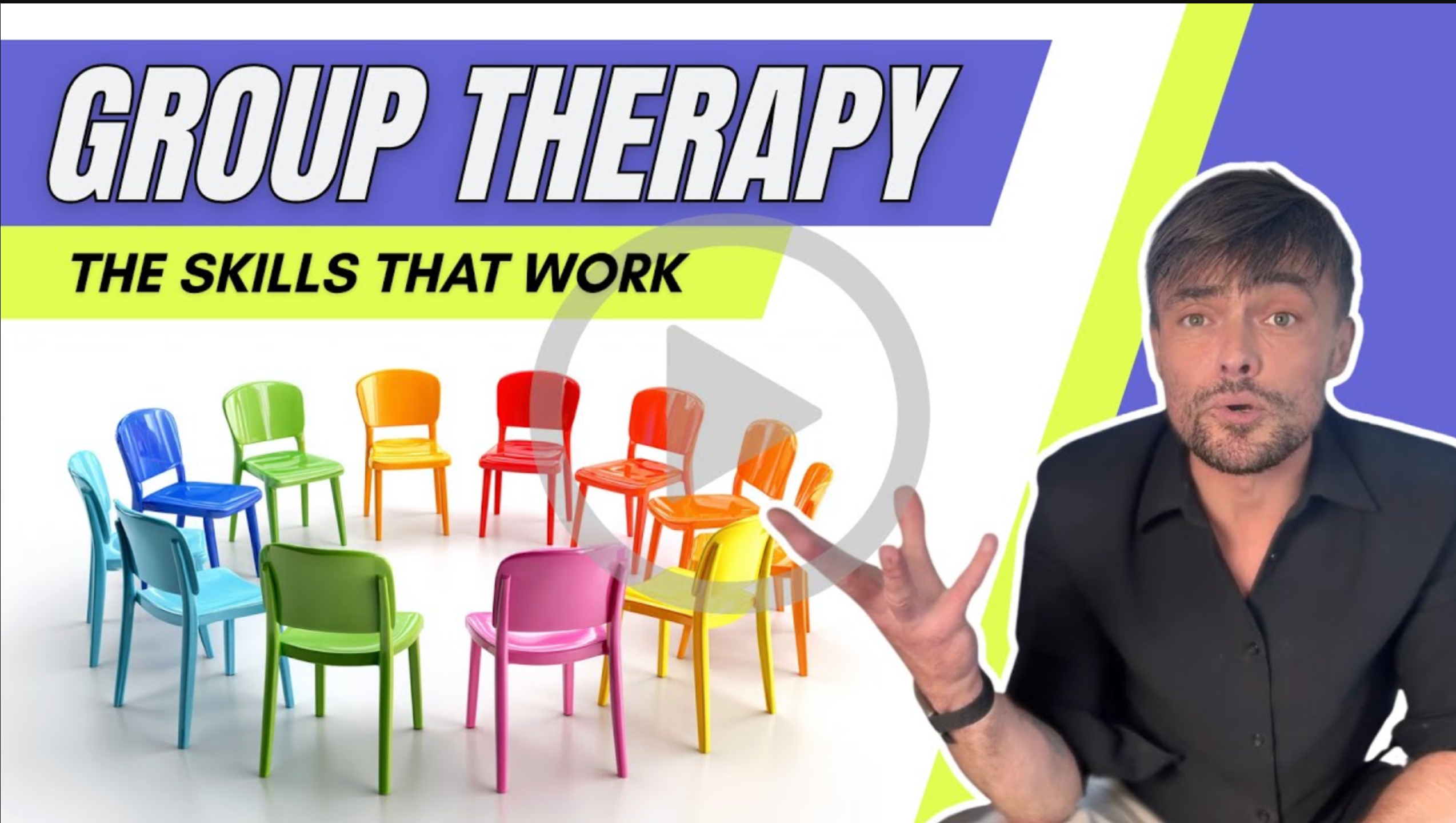
How To Run A Process Group: The Process of Group Formation
If you're running a process group and need a refresher on some skills and activity ideas. In that case, this is a version of the first class I teach graduate students in their psychology program.
Process Group Therapy - Facilitation Techniques And Tools
If you're running a process group, or wondering how to run a process group and are looking for techniques and tools to help your therapy group, check out these four skills
What Is Group Therapy Training?
Group therapy training is the specific preparation clinicians need to facilitate therapy groups effectively. It's different from individual therapy training in almost every way that matters.
Group therapy training teaches you to shift the focus from therapist-to-member to a group dynamic. It teaches you to read what's happening at the group level and how to encourage the group to interact in the way it's supposed to. The shift is from doing one-on-one therapy with an audience to facilitating a group is foundation of a good group training.
What Group Therapy Training Programs Miss
Most group therapy training programs in graduate programs are one semester long, and depending on the instructor, can be theory heavy.
Neither of those are helpful for a new therapist sitting in a chair at a community mental health center wondering why her group of eight people has been staring at the floor and not talking.
GTX is specifically built for that therapist who are looking for skills and techniques to facilitate a process group
What You'll Learn: The GTX Group Therapy Curriculum
GTX is six modules of online group therapy training, each built around a specific clinical challenge.
Every lesson is video-based, self-paced, and designed to be immediately applicable.
Module 1 — What Is a Process Group?
Before you can facilitate well, you need a clear map of what you're actually doing. Module 1 covers the full spectrum from social groups to interpersonal process groups, the four roles the group therapist plays simultaneously, and the foundational distinction between content and process.
Most new therapists know this distinction exists. This module is about understanding it well enough to actually use it.
Module 2 — The Five Skills You Need to Run Any Group
This is the core of the course. Five specific facilitation skills, each taught in its own lesson:
- The Group Agreement. Not paperwork. A live clinical instrument. Every member breaks it. That's the point. Breaches are how the group shows you what it can't yet say.
- Bridging. How to stop running individual therapy in front of an audience and create direct emotional contact between members.
- Progressive Emotional Communication. How to help members move from thoughts to feelings to feelings toward other people in the room. This is the engine of a working group.
- Countertransference. How to use what the group makes you feel as clinical information rather than something to manage or suppress.
- Object-Oriented Questions. How to restart a stuck group with a single question, without triggering defensiveness or putting anyone on the spot.
Module 3 — Immediacy: The Here-and-Now in Practice
Yalom talks about the here-and-now constantly. Most therapists leave training knowing the concept and having no idea how to actually do it.
Module 3 covers what immediacy is, when to use it, and five specific techniques for bringing it into session without derailing what the group is already working on.
Module 4 — Working With Anger in Group
Anger is the most misunderstood dynamic in group therapy. Most new therapists try to contain it, neutralize it, or apologize for the member who expressed it. All three responses make things worse.
Module 4 covers how to think about anger clinically: the spectrum from withdrawal to attack, the narcissistic defense, the three positions of attacker, target, and bystander. Then the practical how-to. What to do when anger breaks out, how to handle negative transference when the anger comes at you, and how to work with the specific member types who bring anger into the room differently.
- 4.1 — How to Think About Anger in Group
- 4.2 — How to Handle Anger: The Therapist's Navigation
- 4.3 — Angry Group Members: The Attacker, The Self-Attacker, The Help-Rejecting Complainer, The Therapist-Attacker
Module 5 — Problem Members
The most-searched topic in group therapy training, by a significant margin. This module covers the specific member archetypes that trip new facilitators up most:
- The Monopolizer. Why they monopolize, what it defends against, and specific language to redirect without rupturing the relationship.
- The Storyteller. The member who fills the room with narrative while never actually arriving in it.
- The Silent Member. The critical distinction between the member who is wounded and the member who is guarded, and why getting this wrong can harm both of them.
Module 6 — Group Resistances
Module 6 moves from individual member dynamics to the group-as-a-whole. When the whole group colludes to stay on the surface, the polite stuck group where everyone is technically participating and nothing is happening, that's a group resistance.
This module covers what it is, how to recognize it, and how to work with it without shaming the group or triggering a collective defensive response.
Frequently Asked Questions About GTX Group Training
Is group therapy as effective as individual therapy?
What is the difference between a process group and a psychoeducational group?
A psychoeducational group is structured around a curriculum — the therapist teaches skills, delivers content, and guides members through worksheets or exercises. A process group, by contrast, has no fixed agenda; instead, the therapist uses the live, here-and-now interactions between members as the primary therapeutic material. The shift from teaching to facilitating is one of the most challenging transitions a therapist makes, and it is the central focus of the GTX training.
How do I handle a difficult or disruptive group member?
Difficult member behavior — whether it is monopolizing the conversation, withdrawing into silence, or rejecting every suggestion the group offers — is not a problem to be managed; it is clinical data to be understood. Each of these patterns communicates something about the member's relational history and their anxiety about being in the group. The GTX course provides specific, word-for-word intervention frameworks for the most common member archetypes, so you can respond with curiosity rather than anxiety.
How do I build cohesion in a group that keeps losing members or has rolling admissions?
Building cohesion in an open or rolling-admission group requires a different set of tools than a closed, long-term group — and most training programs do not address this distinction. The key is creating a consistent structural container (through a well-constructed group agreement) and using bridging techniques that generate emotional contact between members regardless of how long they have been in the group. When the therapist knows how to activate the here-and-now, even a single session can produce meaningful connection.
Do I need prior group therapy experience to take this training?
No, but the GTX course is designed specifically for therapists who are new to group facilitation, including interns, newly licensed clinicians, and experienced individual therapists who are running their first group. The course assumes you're at least a year or so into a training program. The course begins with the foundational question of what a process group actually is and builds progressively through core facilitation skills, immediacy techniques, conflict management, and problem member interventions. If you have already been running groups and feel stuck or under-confident, the course will give you a clear clinical framework to understand what has been happening and exactly what to do differently.
Is In-Person or Live Group Therapy Training More Effective?
Absolutely - and I highly recommend it. I think this course is going to be useful regardless though as it focuses on skills and techniques. Nothing will beat the live learning you get from being in a training group or demo group as part of a group therapy training. If you're in Los Angeles check out GPALA and for the rest of North America AGPA