
Group Therapy Worksheets for Adults (PDF)
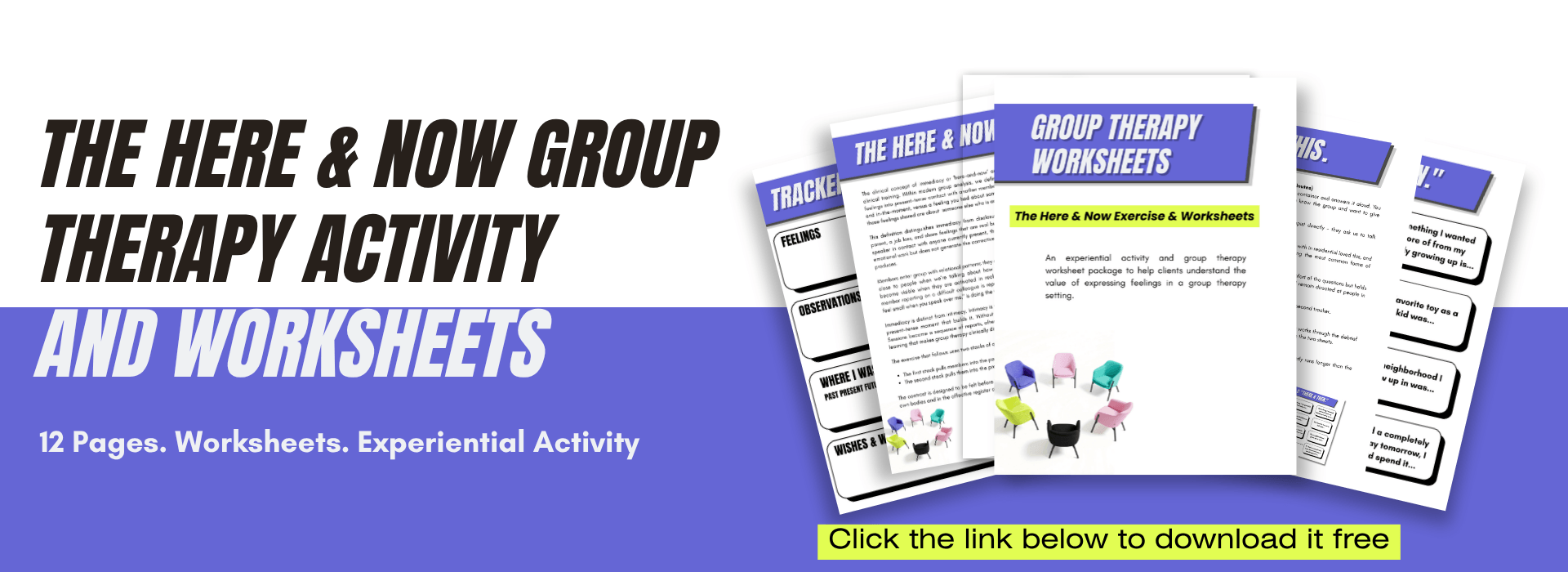
Download free Group Therapy Worksheets for Adults (PDF), designed by a Certified Group Psychotherapist to help groups improve emotional communication and understand the clinical concept of the here and now. I've been running groups for ten years, as well as teaching group process to graduate students, and I find this activity genuinely transformative — particularly for groups that have settled into storytelling and need a way back into live relational contact.
TL;DR: Download a free group therapy worksheet and experiential activity to help your group learn about emotional communication in the here and now.

What Is A Process Group -Group Therapy Worksheets for Adults (PDF)
A process group usually consists of 5- 8 people who meet with a therapist regularly, the work may use a curriculum or a worksheet but usually the focus is on the live relationships unfolding between members in the room.
Instead of teaching you about your patterns, it lets them show up in real time with other people, so you can feel them, name them, and try something different while everyone watches and helps. The room becomes a kind of social mirror: what you do here is almost always what you're doing out there. You can read more about group therapy techniques here
What Are Group Therapy Worksheets for Adults
Group therapy worksheets for adults are structured written tools that therapists use to support the work of a therapy group by helping members articulate feelings, track their internal experience, reflect on patterns, and engage more deliberately with the people in the room.
In my experience the best group therapy worksheets combine a moment of self reflection, followed by some processing around the activity or answers that the worksheet generated.

Free Printable Group Therapy Worksheets (PDF)
What The "Here and Now" Means in Group Counseling
Every group therapist knows the here and now is where the work happens. The concept appears in training, in supervision, in every major text on group process from Yalom forward. And yet most process groups spend the majority of their time somewhere else entirely — in members' childhoods, in conflicts with partners who are not in the room, in hypothetical futures where things will eventually be different.


Download the Free Group Therapy Worksheet & Experiential Activity.
What Is Inside this Group Therapy Worksheet Download:
Written By A Group Therapist
Hi! I'm Oliver Drakeford, a Licensed Marriage and Family Therapist in West Hollywood California.
I'm a Certified Group Psychotherapist and have been practicing for over a decade. I occaisonally moonlight as an Adjunct Professor, teaching Group Process and prior to being in Private Practice full time, I was the Clinical Director of a residential treatment program for adolescents in Malibu, CA.
I started a YouTube Channel to share some of the things I was teaching in my Group Process class and to share some of the things that I was saying to my treatment team and the people I supervise. The videos have been viewed nearly a million times (which totally blows my mind) with my Group Therapy Playlist being the most popular.

Most Group Therapy Worksheets for Adults Keep the Conversation in the Past.
This One Doesn't.

Sign up for my free weekly group therapy newsletter for more group therapy tips and activities. Click here or the image above.
How Does Group Therapy Help?
Group therapy is an excellent way for clients to improve their relationships and gain a deeper understanding of self and interpersonal dynamics, the best part is that it can supplement work done in individual therapy, and act as a stand-alone format of treatment..
Communication Skills
- Members learn effective communication.
- Group helps you speak up constructively.
- In group you learn to handle interpersonal conflict and tension with increasing ease.
Emotion Regulation
- Group helps understand and express feelings.
- You develop a capacity to observe and withstand uncomfortable feelings.
Healthy Relationships & Boundaries
- You will develop an increased ability to recognize others as different from oneself.
- You explore and tolerate others having different thoughts feelings and drives, and learn to maintain relationships with them.
- You will create meaningful interactions with others in group and in every day life.
Insight & Self Awareness
- Group helps you gain insight into how you operate internally and in relation to others.
- You can try new ways of being with others
5 Group Therapy Myth Busters
Group therapy has a strange number of myths and false rumors about it, here's some of the top myths I hear about group therapy and why they're wrong.

Group cohesion is the goal for group
A groups structural cohesion is a frequent feature in both the clinical and research literature. However, There is no consensually agreed-upon operational definition of the term, which makes clear analysis and studying difficult. In some research, cohesion has not been shown to reliably affect client outcome, and in 2009 it was suggested that it was appropriate to drop cohesion as a focus of scientific investigation.

Group Is Only Effective For Some Diagnosis
Overall, the general trend has been that group therapy has been shown to be an effective form of therapy for many types of diagnosis, including depression, anxiety, mood disorders, schizophrenia, PTSD and addiction.
This is not to say that any group will work, as studies are emerging that suggest certain types of groups benefit different diagnosis more than other.

Anyone can run a process group
Unfortunately for group therapists we need more studies that address the complex relationship between training and treatment outcomes. However, we do know that group therapy is most effective when group leaders take advantage of the unique interactive properties of groups and incorporate group process principles into treatment. This requires a deeper level of training than offered in most schools.

Group conflict is a sign of something bad
Group conflict can be a source of anxiety and stress for both members and the group therapist. This does not mean however that it should be avoided. In fact, research found that “cycles of interpersonal exploring followed by retreating to safety” were positively related to outcome. This makes more sense when relationship dynamics are considered more broadly, the nature of relationships involves both rupture and repair.

Individual therapy is more effective than group
Research conducted over 25 years is actually suggesting that in fact group therapy is just as effective as individual therapy. Recent meta-analyses of a quarter century of writing have found not found any differences between effectiveness of the two modalities, although more studies should be done to explore 'types' of group therapy to give us more information on this.
Other Types Of Group Therapy Worksheets Coming Soon.
Emotional Regulation Worksheets for Group Therapy
CBT and DBT Group Therapy Worksheets for Adults
CBT and DBT are the two most widely used evidence-based frameworks in adult group therapy, and I’ve found to be very popular in residential treatment. Their worksheet traditions reflect very different theories of change which makes them worth understanding separately before deciding which one belongs in a given session. I also find a lot of eye-rolling and boredom in some groups.
A systematic review and meta-analysis of 23 studies found group CBT produced a significant effect over usual care for depression immediately post-treatment (SMD = −0.55, 95% CI: −0.78 to −0.32), with benefits maintained at medium- to long-term follow-up.
Coping Skills & Coping Strategies Worksheets
Conclusion and Final Thoughts
This is a great activity that accomplishes several things - it shows group members how to communicate emotions, introduces the concept of the here and now, and allows the group to have a lived experience of group process.
