How to Run a Therapy Group: A Clinical Framework for the First Session
Apr 09, 2026
How to run a therapy group is one of those questions that sounds deceptively simple. Until you're sitting in a circle with six people, the session has started, and nobody is saying anything.
How to Run a Therapy Group When the Room Goes Silent
You had the group therapy semester in grad school. Maybe ten weeks. If your professor was thorough, you got a demonstration group as part of the course. Most clinicians I've spoken to didn't have that.
So here you are. The session starts. And then nothing. Silence. The kind where you start doubting every professional decision you've made that led you to this particular room.
There is a technique that addresses this directly. It comes from modern group analysis. In plain terms, this is a framework built around treating the group like something that matures over time. Each intervention is calibrated to where members are relationally, not just what they're discussing. I'm Oliver, I'm an LMFT and a CGP. The CGP is a certified group psychotherapist, letters you can earn through AGPA, the American Group Psychotherapy Association. If you work with groups at any level, find AGPA. Their training is worth every minute.
Here's the framework.
Here's the framework.

Join my free weekly group therapy newsletter here for more group skills and techniques.
First, Know What Kind of Group You're Actually Running
Most clinicians are thrown into groups without a clear sense of what type of group they're actually facilitating. That ambiguity costs you in the first session, for the record, it totally happened to me too.
Think of groups on a spectrum.
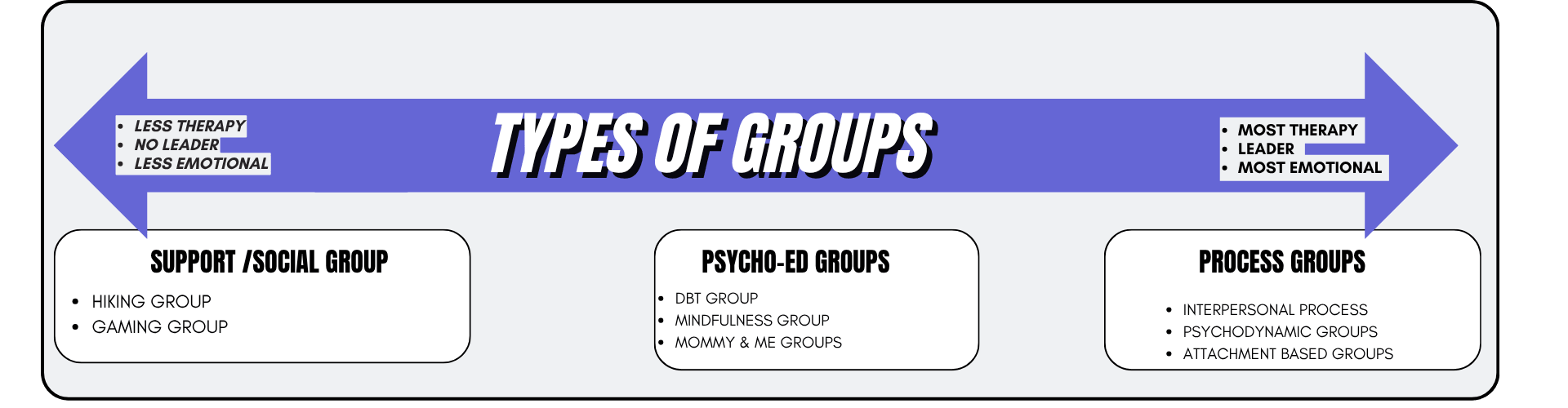
At one end: leaderless social groups. A dog-walking meetup, a book club, a neighborhood hiking group. Moving toward the middle: structured groups with a designated leader, defined goals, and learning objectives. A parenting class. A grief support group. A psycho-educational session on anxiety management.
An AA meeting sits somewhere in the middle here- there's organization to it, a speaker structure, a sharing format. But there's no cross-talk, no interpersonal processing. The group looks inward, not between members.
At the far end sits the process group.
A process group is defined by its interpersonal focus. What happens between people in the room is the clinical material. How members relate to each other, react to each other, and affect each other — that is the work. Research consistently shows that group cohesion, the quality of the relationships between members, is among the strongest predictors of therapeutic outcome in group settings.
What Is A Process Group
A process group consists of six to eight people broadly looking to improve how they relate to themselves and others. One of the primary goals is helping members find out what gets in the way of that. Communication, conflict tolerance, the capacity to sit with someone who sees things completely differently from you, those are the things a process group is built to address.
Knowing this changes your preparation. You're not delivering content. You're holding a relational space. Those are different jobs.
What Actually Happens When You Walk In Without a Frame
Here's what groups do not do spontaneously.
They don't begin having profound insights. Nobody becomes unafraid of conflict overnight. And they certainly don't start speaking directly about the patterns that have blocked them from connecting with people for years.
They joined this group because they can't do those things yet. That's the whole point.
So what does happen? In my experience, one of four things. The group sits in silence and waits for you to put on a show. Someone appoints themselves as the group therapist, and this can be as subtle as "why don't we all introduce ourselves?" Someone launches immediately into their most private material with no warm-up. Or one person, let's call him James, takes the floor and doesn't give it back.
There's a developmental reason for this. People regress in group settings. They revert to younger, more primitively organized versions of themselves. APA has identified group psychotherapy as a distinct evidence-based specialty specifically because group dynamics require techniques that don't translate from individual therapy. Regression is one of the core reasons why.
This isn't a failure of your group members. It's a predictable feature of unstructured group space. Which means it's entirely addressable. The thing that addresses it is the group agreement.
The Group Agreement: The Most Underused Tool in Group Therapy
The group agreement is not a rulebook. The goal is not compliance. Being clear about this reshapes how you use it.
The agreement is a clinical frame. Think of those bumper rails at a bowling alley. The ones that sit in the gutters and nudge the ball back toward the lane. They serve no purpose other than helping people find their way into the work.
When someone breaks the agreement, and they will, the breach is information. Nikki arrives late. The agreement says to come on time. In another context you might correct her. In a process group, you ask.
- "Hey Nikki, I noticed you were a little late — what's going on?"
Maybe it was traffic. Maybe she's furious with you. Maybe Michael had an angry outburst in the last session and she's been dreading coming back all week because it reminded her of her father. You won't know until you ask. And you can ask because she agreed to a frame that makes the question clinically legitimate.
Every breach is an opening. James monopolizes the floor. That's information about James, and about the group's reluctance to confront him. The whole room goes silent. And between you and me, a silent group is almost always either angry or afraid. Those are not the same clinical situation, and knowing that changes how you intervene.
The agreement gives you permission to ask about any of it.
The FRAME Protocol: How To Run A Process Group Agreement
Setting the agreement up well at the start of a group changes how the entire group runs. Here's the sequence.
F — Frame the purpose before listing anything.
Tell members why you're doing this. Something like: "I want us to agree on some basics so we're all on the same page." This positions it as collaborative rather than procedural.
R —Run through the five non-negotiable
- Come on time.
- Stay for the full session.
- Respect the confidentiality of every person in this room.
- Use a fair share of the time. And most importantly:
- Put your thoughts and feelings into words, not actions.
A — Ask members to contribute their own additions.
This step matters more than it looks. When I worked with teenagers in residential treatment, calling it a "group contract" produced instant resistance. Calling it an agreement and inviting them to add to it changed the room. They had bought in because they helped build it.
M — Make the agreement explicit.
Get a nod, a raised hand, something that signals conscious agreement rather than passive acceptance. Silence is not consent here.
E — Explain that breaches are expected.
This is the step most clinicians skip, and it's the most clinically important one. Tell the group from the start that everyone will break the agreement at some point. When it happens, the group's job is to get curious, not punitive.
When you set it up this way, Nikki arriving late stops being a disruption. It becomes an opening.
The FRAME protocol draws from modern group analysis, which treats every intervention as calibrated to where the group is relationally, not just what topic is being discussed. AGPA offers training in this framework that's worth seeking out if you work with groups regularly.
The tools and techniques of Modern Group Therapy are definitely something I talk about in my weekly Group Therapy Newsletter too.
Oliver's Final Thoughts On Process Groups
The group agreement is the first technique I teach every time I teach group. Not because it's the most sophisticated, but because without it everything else is harder than it needs to be.
It gives the group a shared language for what they're there to do. It gives you permission to notice when they're not doing it. And it turns what would otherwise feel like a clinical emergency into material the group can actually use. Dead silence. A member who won't stop talking. Nikki arriving late again. All of it.
Set it up in the first five minutes. Get explicit agreement from every person in the room. Tell them breaches will happen. Then see what the first breach teaches you about who's in it.
Sign up for my free weekly group therapy newsletter at My People Patterns. One technique, one concept, one clinical idea per week for practitioners who want to be sharper in the room.
How to Run a Therapy Group FAQs
How do you start a therapy group for the first time?
Start with the group agreement before any other content. Outline five core expectations: arriving on time, staying for the full session, respecting confidentiality, using a fair share of the time, and putting thoughts and feelings into words rather than actions. Get explicit buy-in from every person in the room. Tell them that breaches will happen. The group's job when they do is to get curious, not correct. This frame does more for a first session than any icebreaker.
What is a process group in therapy?
A process group is a therapy group whose primary focus is the interpersonal relationships between members. Rather than following a structured curriculum or delivering psychoeducation, the therapist holds a relational space in which members explore how they interact with each other, what blocks connection, and how patterns in the room reflect patterns in their lives outside it. Groups typically run with six to eight members.
What should you do when a group member breaks the rules?
In a process group, a breach of the group agreement is clinical material, not a disciplinary problem. If a member arrives late, the question isn't how to enforce punctuality. It's what the lateness might mean for that member and for the group. You explore it with curiosity. The agreement exists precisely to make that kind of exploration possible.
How many people should be in a process group?
Six to eight members is the standard. This is large enough to generate meaningful interpersonal dynamics and small enough for every member to have a genuine presence in the room. Residential settings sometimes run larger groups for practical reasons, though the clinical trade-offs are worth considering.
What is modern group analysis?
Modern group analysis is a theory of techniques applicable across different types of therapy groups. It draws from a maturational and developmental framework, meaning interventions are calibrated to where the group is relationally, not just to what is being discussed. The therapist's job is to help the group move toward more open, direct, and emotionally available communication, using the relational dynamics in the room as the primary clinical tool.