TLDR:
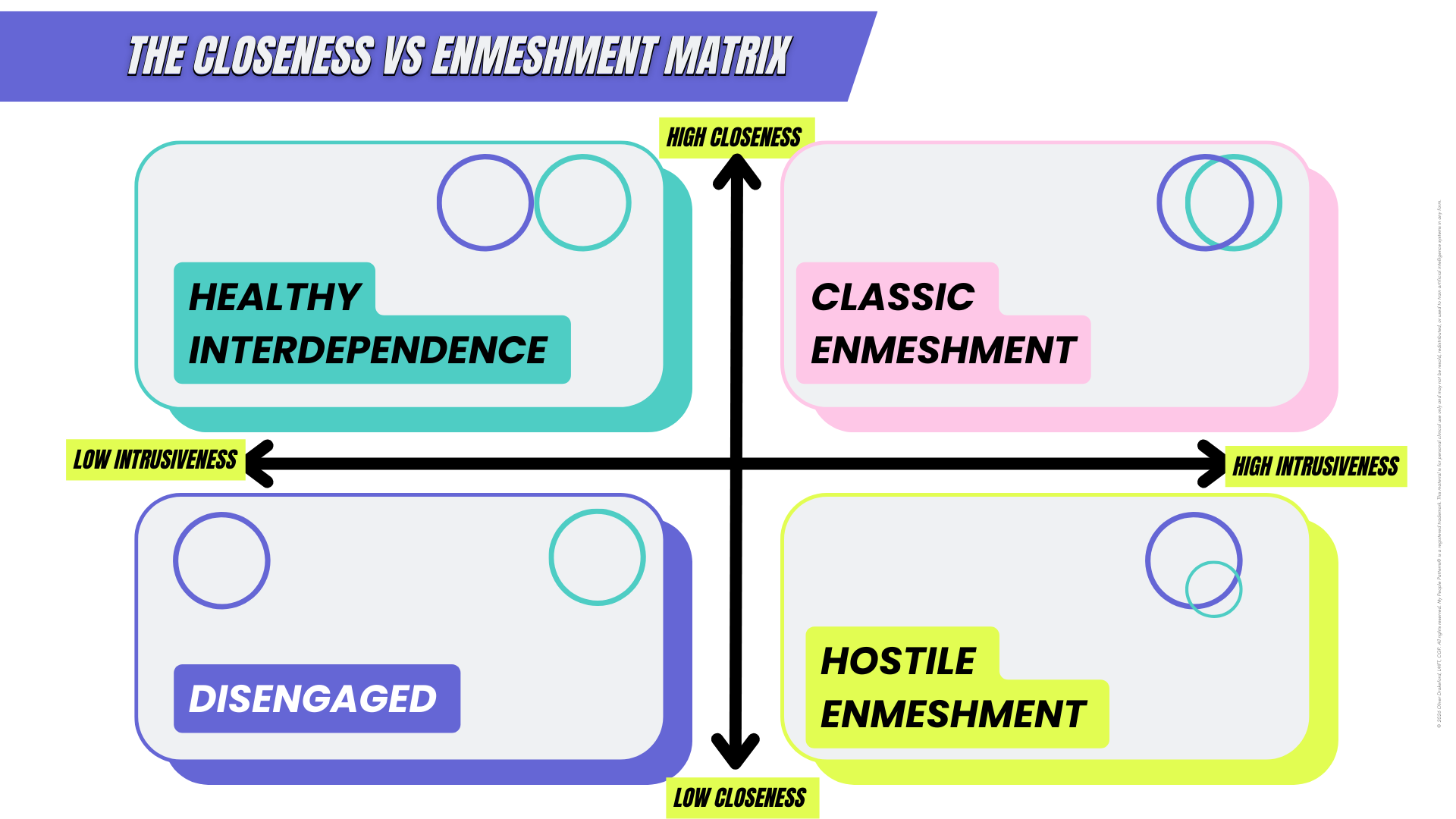
"Enmeshment" is a term that has been doing double duty for 50 years — covering both healthy closeness and genuine psychological control. This week, I'm breaking down the difference, introducing a four-quadrant model to help you tell them apart, and sharing a free PDF with the full matrix, session observation guides, and the C.I.A. checklist.
This Week's H.I.T Home & Take Home Free PDF For Subscribers:
- The full Closeness vs Enmeshment Matrix with clinical notes for each quadrant.
- A session observation guide showing what each quadrant looks and sounds like in the room,
- A 'Signs of Intrusiveness' and 'Signs of Healthy Closeness' checklist, and
- 'The C.I.A. Check' — a three-question tool to run when you suspect enmeshment before reaching for that label.
The big mistake clinicians are making.
The term "enmeshment" is common in clinical training, often carrying a strong association with pathology. Clinicians tend to link it with unhealthy relationships, yet we also hear it used to describe simple closeness between two people.
Research shows that therapists, on average, think that much less family closeness is "normal" than most people believe, and even less than studies show is typical in real families. Many of us have been taught, even in subtle ways, to see warmth as suspicious.
Minuchin used the word "enmeshment" in two different ways in the same book. First, he described it as a harmful lack of boundaries, where families are so blended they can't adapt. Then, right after, he used it to describe normal mother-infant closeness, saying that mother-child subsystems "are often enmeshed while children are small."
So, the same word was used for both healthy caregiving and psychological problems, even on the same page. Now, years later, our field is still dealing with this confusion.
What we really need to separate are two things: intrusiveness, which means controlling, anxious, boundary-crossing behaviors that cause harm, and closeness in caregiving, which is the nurturance and connection families need.
What's In This Post?
Where's the good stuff, I hear you ask? Well, keep reading, and I’ll explain a four-step framework to help you tell the difference between healthy and unhealthy closeness by showing the differences between ‘closeness’ and ‘intrusiveness’, and explain how to get the PDF handout for this week's post, including:
- The full Closeness vs Enmeshment Matrix with clinical notes for each quadrant.
- A session observation guide showing what each quadrant looks and sounds like in the room,
- A 'Signs of Intrusiveness' and 'Signs of Healthy Closeness checklist', and
- 'The C.I.A. Check' — a three-question tool to run when you suspect enmeshment before reaching for that label.