

What's the difference between a family that's close and a family that's enmeshed?
Most of us would say 'degree'. Closeness is fine; enmeshment is just too much. Turn the dial far enough in one direction, and warmth becomes suffocating. Too far in the other direction, and you get a disengaged family where no one really shows up for anyone.
That's the model most of us trained on. And it's a reasonable starting point. But it has a blind spot — and that blind spot has real consequences for how we assess families and where we aim our interventions.
The Boundary Spectrum
You already know this part, so I'll keep it short — but it's worth naming clearly because everything else rests on it.
In structural family therapy, boundaries are the invisible rules that regulate the extent of contact and access family members have with one another. Minuchin described three types.
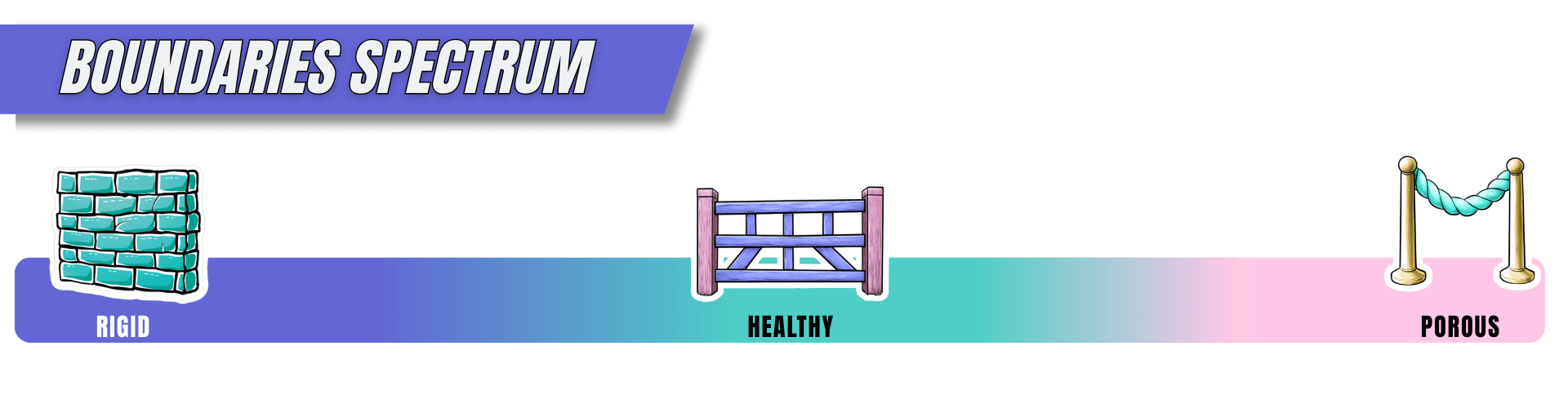
Porous boundaries are the marker of enmeshment. There's very little separation between individuals — feelings spill over, decisions belong to everyone, and having a different experience from the rest of the family can feel like a slight act of disloyalty.
Rigid boundaries sit at the other end. Contact is limited, and emotional access is low. Family members can be physically present but entirely unreachable. This is the structural signature of the disengaged family.
Healthy,clear, flexible boundaries are the goal. Firm enough to protect individual autonomy. Permeable enough to allow authentic connection and mutual support when it's needed.
In practice, most families sit somewhere on the spectrum between diffuse and rigid — rarely at the extremes, but often closer to one end than they realize.
The Enmeshment Continuum
Murray Bowen, one of the founding figures of family systems theory, identified two forces that pull at every family simultaneously.
Togetherness: The first is the togetherness force — the desire for more belonging, mutual support, and connection
Autonomy: The second is the autonomy force — the drive toward individual experience, separate opinions, and the right to be a distinct person inside the family.
Both forces are healthy, but they are totally contradictory and place us in a bit of a paradox.

Enmeshed Families
When a family operates with diffuse, porous boundaries, the togetherness force tends to win by default. There's simply not enough structural separation to resist it. Loyalty stops being a value and starts being a requirement. Having a different opinion, a different feeling, or a different life than the rest of the family can quietly register as a small betrayal. Care feels unconditional. But it comes with the expectation that most family members couldn't name it if you asked them.
Disengaged Families
At the other end, rigid boundaries push the autonomy force into the foreground and make genuine togetherness hard to come by. For someone who grew up inside that, it often meant learning early that needing something from others was either futile or costly.
Interdependent Families
Interdependence sits in the middle — not as a watered-down compromise, but as a genuine balance. Connected enough to lean on someone. Separate enough to stand on your own. Clear enough boundaries that both forces have room to exist without one swallowing the other.
Some clients had a porous boundary with one parent and a rigid one with the other. That combination is harder to map and tends to yield a more complex, contradictory belief system about what closeness is supposed to feel like. It's also worth noting that how far a client places their family from the middle is itself a clinical signal — the more extreme the placement, the more entrenched the core patterns are likely to be.
The Caretaking Compass
The continuum is a good orienting tool, but it has a structural limitation. It treats enmeshment and disengagement as opposite ends of the same line — as if moving away from one automatically moves you toward the other. In practice, that doesn't always hold. Some families are both cold and controlling. Some are warm and still able to respect each other's individuality. The single continuum can't account for complicated combinations.
I love a good spectrum that I can turn into a quadrant, and when we do that, we create two distinct dimensions: focus on self and focus on others. Instead of seeing these as points on a single line, treating them as separate axes gives a clearer, two-dimensional map of family dynamics. Each axis ranges from low to high, creating a grid with four quadrants.
When you place self and others focus on separate axes, families and individuals can be located anywhere in this two-dimensional space, creating four distinct clinical profiles based on combinations of high or low focus on each axis.
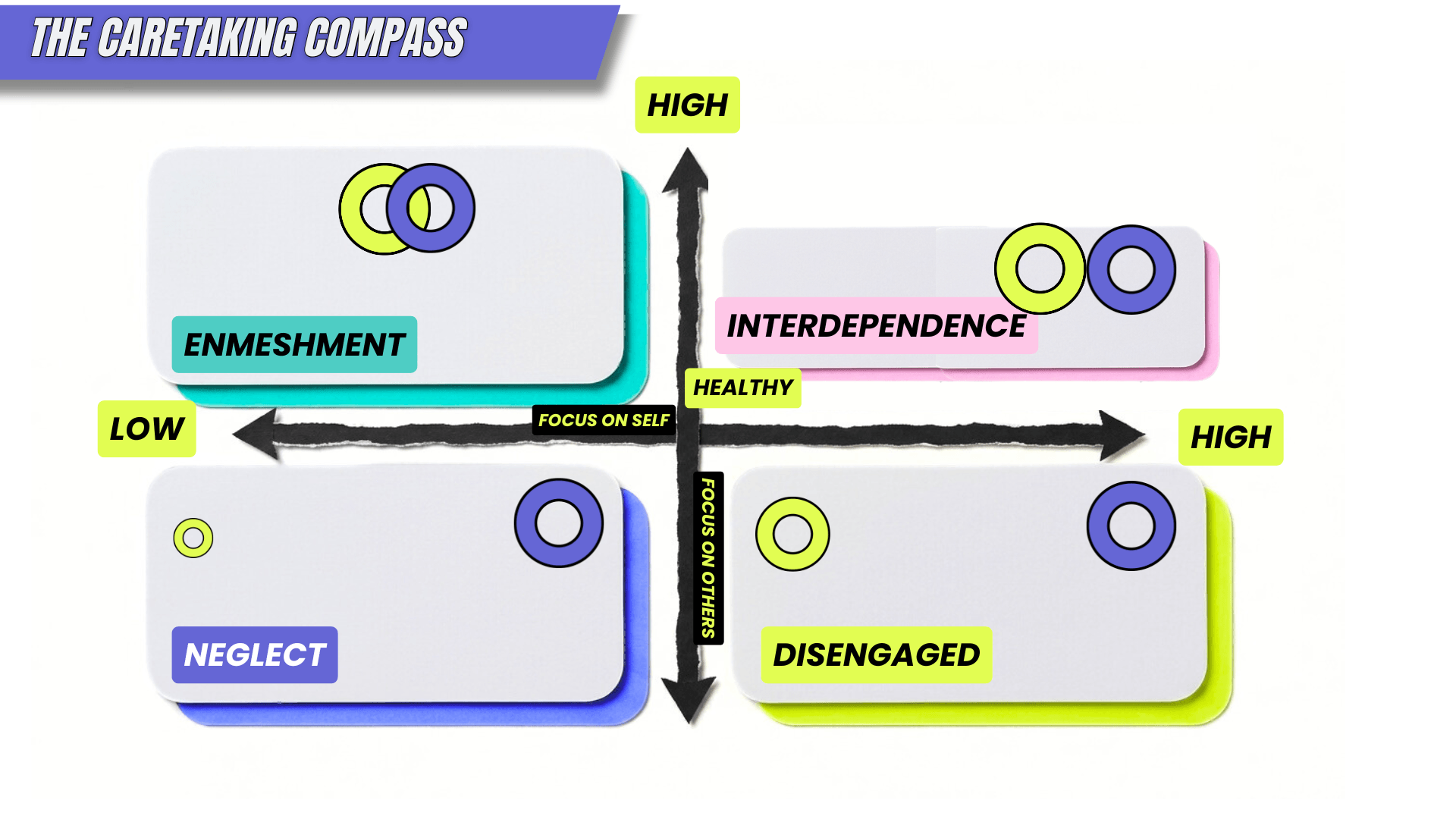
High focus on others, low focus on self. This is the enmeshed territory. The individual organizes almost entirely around other people's needs, gives generously, and experiences significant guilt or anxiety when they attempt to attend to their own. The relational economy is entirely outward-facing. This is also often where the presenting complaints are quietest — because the person doing all the giving is usually not the one who called to make the appointment.
High focus on self, low focus on others. This maps onto the disengaged end. Individuals who learned to fend for themselves — often out of necessity — and who developed habits of autonomy that make it genuinely difficult to orient toward others. This isn't selfishness in the way we usually mean that word. It's more often a survival pattern that outlived its original purpose.
Low focus on both. This is the burnout or neglect quadrant — the person who has nothing left for anyone, including themselves. You sometimes see this in individuals who have been operating in the first quadrant for a long time without any replenishment or support. The giving economy eventually collapses.
The Middle - Interdependence — the capacity to be genuinely present to others while remaining present to your own experience. It's the clinical goal. It's also rarer than it sounds, particularly for clients who were never shown it as a template.
The practical reason this matters is that the single continuum can make it seem like your only options are to care for others or to care for yourself.
The Caretaking Compass makes visible something those clients often find genuinely surprising: that caring well for others and caring for yourself are not in competition. You can do both. And helping clients begin to see that is sometimes the most significant early move in the work.
Three Families Walk Into Your Office...
The diagram below is designed to be your quick reference for the moment a family walks into your office and you're still trying to orient. It focuses specifically on what you observe in the room — the behavioral and interactional data that's available to you before anyone has said anything particularly meaningful. Not what clients report about their history, not what they believe about their family, just what is visibly happening in front of you in real time.
What makes this useful clinically is that families rarely arrive with a label. They arrive with seating choices, with who speaks first, with how they respond when someone says something the others didn't expect. The three columns give you a framework for reading those moments quickly — not to diagnose, but to orient. You're looking for where the family's center of gravity seems to be sitting, so you know which patterns to track and which questions to start pulling on.

Until next time,
Oliver & My People Patterns
`


Responses