What Is The Here and Now in Group Therapy? (and how to do it)
May 29, 2026
Here and Now in Group Therapy: What It Is, Why It Matters, and How to Use It in Process Groups
By Oliver Drakeford, LMFT CGP
Here and now group therapy is built on one deceptively simple idea: what's happening between people in the room right now is more therapeutically alive than anything they brought in from last week. Here's what that means in practice, and three skills so you know how to use it in your next group.
What Is Immediacy or "Here-and-Now" Group Therapy?
Think about the last time your group went quiet after someone got mad at another group member and yelled. Feelings expressed in the here and now, even the less pleasant ones like anger, have the potential to shift the group's interactions and vulnerability.
Immediacy, as modern group analysis frames it, means bringing feelings into present-tense and preferably into contact with another person who's actually in the room. A member can be expressing genuine emotion and still not be working in the here and now if they're discussing something emotional that happened in the past. To make group effective, we want to help our groups express their current feelings, especially those directed toward someone present.
As a certified group psychotherapist and LMFT, I use an experiential activity in groups and group training to make this concrete. I give the group questions in two rounds, the first pulls on historical content, things that happen in the past. The second round is about thoughts and feelings to people who are in the room.
Every time I run this, the pulse of the room shifts dramatically in the second scenario. You can hear a pin drop. People lean forward. My own heart rate goes up - it's quite stressful, but enlivening too.
That second scenario is here and now group therapy working.
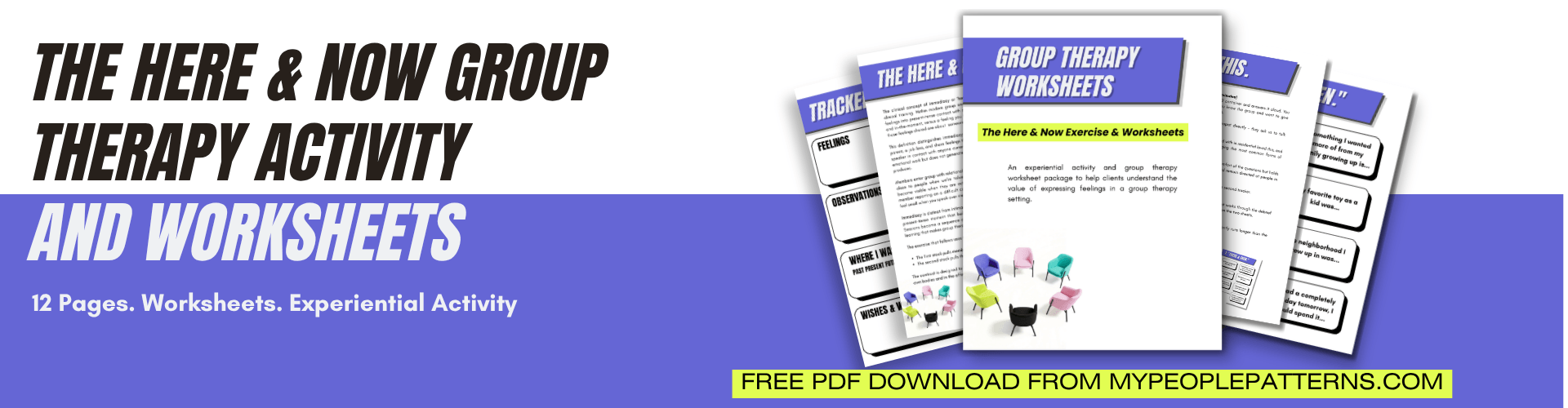
Want a free printable exercise to run this with your group? I've put together a PDF and worksheet that walks you through the full two-round version, including a tracker sheet for members, a debrief guide, and tips for holding the frame when members resist. You can grab it here.
How the Group Functions as a "Social Microcosm"
You've probably heard in your group therapy training in grad school that group becomes a social microcosm, a living replica of each member's relational world. Members don't describe their patterns; they enact them.
- Ken intellectualizes when he's scared.
- Barbie gives advice when she can't tolerate someone else's pain.
- Nicky avoids conflict with everyone
These patterns surface in group because the group pulls for them but because the group is just a microcosm of daily life too.
What makes this clinically useful is that the group gives you multiple live shots at the same dynamic. In couples therapy, you wait for an enactment. In family therapy, you work with what the family system produces in the room. In group, you get eight people generating relational data simultaneously. That's a lot of material to work with.
The group-as-microcosm only activates when members are actually in contact with each other, which is why the here and now matters so much. A member who talks exclusively about their life outside the room stays behind glass. The group can feel for them, even care about them deeply, but the relational work that produces real change requires that they step into contact. When they do, other members feel it. Ken has feelings about what Barbie just said. Barbie has feelings about how Ken responded. Those feelings are the therapy.
The Role of Interpersonal Learning and Real-Time Feedback
Irvin Yalom described interpersonal learning as one of the most powerful mechanisms in group therapy. It operates through two channels: a member learns how their behavior lands on others, and they get to experience healthier relational patterns inside the group itself. Both channels require real-time interaction — they can't be simulated through storytelling about the outside world.
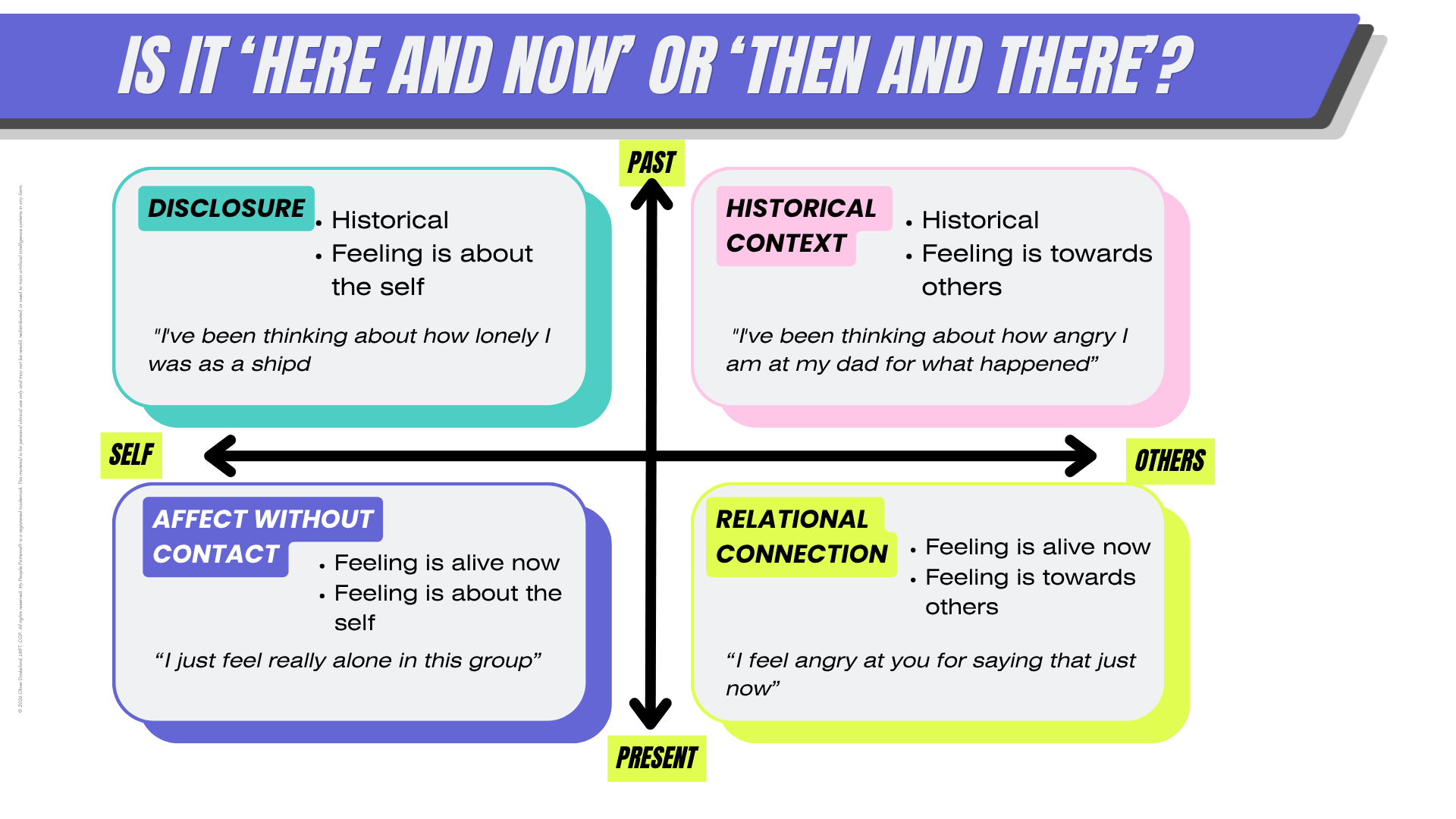
Modern group analysis adds a useful distinction here. There are two types of feelings a member can share: feelings they have inside themselves, and feelings that go toward another person. Both are valid. Only the second puts the speaker in contact with someone in the room.
When a member talks about their divorce, a difficult parent, or a job they hated, those feelings are real. They can also produce good clinical material. But they don't produce the same relational experience as saying to another group member: "When you said that, I felt like you didn't want me here." That sentence is uncomfortable to say and uncomfortable to hear. It's also where the real work lives.
More Group Therapy?
Key Benefits of a Present-Moment Therapeutic Approach
The clinical case for here and now group therapy isn't philosophical. It's practical.
When members work in the present moment with each other, they get live feedback on how they actually come across, not how they think they come across. A member might spend years in individual therapy understanding that they tend to push people away when they're anxious. In group, they can watch that happen in real time, notice it, and do something different right there in the room. That's a different order of learning.
Present-moment work also builds group cohesion faster. Research consistently links group cohesion to treatment outcomes in ways that parallel the therapeutic alliance in individual work. When members take the risk of saying something real about each other, and the group holds that rather than collapsing, the sense of safety deepens for everyone. Members start to trust that the group can handle honesty.
There's also something that's harder to quantify but easy to observe: here and now sessions feel different. Members come back. Dropout rates in groups that stay in the past tend to be higher, because nothing feels at stake. When the work involves real feelings toward real people in the room, members are more engaged. It's harder to dissociate through a session when someone might turn to you and say something true.
Process vs. Content in Group Therapy
The distinction between process and content is one of the most useful clinical tools available to a group therapist, and it's also one of the most underused.
Content is what someone is talking about. Process is what's happening between people while they talk about it. A member brings in a detailed account of their stamp collection — organized by country, by date, inherited from their grandfather. That's content. The process question is: what does this person need from the group right now, and what are they doing to try to get it?
In individual therapy, that same stamp collection story might make you wonder about approval, about wanting to be found interesting in a way this person never was at home. In group, you have more leverage. You can see how the room is responding. You can feel the energy shift as people mentally check out. And you can name that — not to shame the speaker, but to bring what's happening in the room into the room.
The process is always happening in the present tense, even when the content is rooted in the past. That's the move: shifting from what someone is saying to what's actually going on between people right now. Yalom called the here and now "the major source of therapeutic power, the pay dirt of therapy." Once you start reading groups through process rather than just content, you can't unsee it.
Why Here-and-Now Interactions Feel More Alive
The stamp collection story produces a particular kind of quiet in a group. Not contemplative quiet. The kind where people are thinking about dinner.
The scenario where someone looks at their therapist and says "I feel like you don't listen to me, and I'm not sure I want to be here anymore" produces a completely different quality of attention. Nobody is thinking about dinner. People's anxiety spikes. Mine does too.
Part of what makes here and now work feel alive is that it involves risk. Telling someone outside the group how you feel about a parent is emotionally real but relationally safe. Telling someone across the circle how you feel about them is neither. Members know the difference. Their nervous systems know the difference. The defenses that come up around here and now work are a direct measure of how much is at stake. That's worth paying attention to, not flattening.
There's also something about timing. A feeling expressed in the moment it arises, about the person who triggered it, in front of the people who witnessed it, carries a different weight than the same feeling reported after the fact. It's still in the body. It can be worked with.
Three Practical Here and Now Techniques for Therapists
These are the three moves I come back to most often when a group drifts out of the present moment.
Translate the Past
Use this when someone is talking about a historical feeling and you have a sense they're actually talking about someone in the room. You translate the content of what they're saying into a here-and-now feeling and try to get them to name it directly.
Say Ken opens group with something like: "I've been thinking about how angry I am at my dad. He was never really there for me, and honestly, even now when I call, nothing's changed."
You might say: "I'd love to hear more about your feelings toward your father at some point, but I can't help wondering if you're actually angry at someone in the group right now — maybe even me."
Ken is free to agree or disagree. It doesn't matter much, because you've opened the door. In my experience, someone in the group will walk through it. The historical memory surfaced for a reason. The here-and-now feeling was already in the room before Ken started speaking.
Block the Rewind
Use this when the group tries to revisit a past conversation — five minutes ago or five sessions ago — and redirect it toward what's happening now.
"Hold on. I want to go back to what Barbie said a few minutes ago — didn't you say you were angry at someone, but you didn't say who?"
You might respond: "Before Barbie answers that — what's coming up for you right now that made you want to go back to that?"
The move isn't about refusing to revisit the past. It's about being curious about what feeling, in the present moment, is motivating the backward pull. Usually there's something too vulnerable to say directly, so it gets disguised as a thought, and the thought takes everyone out of the room.
Stop the Cover-Up
Use this when someone makes an indirect communication — often as advice or a comment about something outside the group — and you suspect it's covering a feeling that's actually here and now.
Barbie says to Ken: "I've been thinking about what you said last week, and I really think you should call your dad. Don't you owe that to yourself?"
You could let it go. The conversation would drift toward Ken's dad and stay outside the room. Instead: "It sounds like you really want Ken to call his dad. What feelings are coming up right now that are behind that?"
Barbie was using advice to cover something she feels — about her own life, and probably toward Ken. Once that's out, Ken has feelings about it. Other people in the room have feelings. All of that is here and now, and all of it builds connection in a way that talking about Ken's dad cannot.
Oliver's Final Thoughts
Here and now group therapy isn't about banning historical material from the room. The past belongs in group. What you're watching for is when the past becomes a place to hide — when the group collectively retreats from something uncomfortable happening between them and packages it as meaningful therapeutic content.
That retreat is readable. The energy drops. People look at the floor. Your own attention drifts. Trust that signal. The most alive moments in group therapy are almost always the ones that feel the most precarious, and your job is to help the group stay in them long enough for something real to happen.
The free PDF and worksheet linked above gives you a structured exercise to help your group understand and experience this distinction for themselves — including how to debrief it, and what to do when members resist.
Here and Now Group Therapy FAQs
What does "here and now" mean in group therapy?
Here and now group therapy refers to a clinical approach, closely associated with Irvin Yalom and modern group analysis, in which the therapist focuses attention on what is happening between group members in the present moment rather than on historical events or outside relationships. The core idea is that feelings expressed in real time, directed toward people actually in the room, produce a different and deeper quality of relational learning than feelings reported after the fact.
How is here and now group therapy different from other group therapy approaches?
Most group therapy formats — including structured CBT groups and psychoeducational groups — organize sessions around content goals: skills to learn, topics to cover, concepts to discuss. Here and now group therapy organizes sessions around present-moment interactions between members. The relationship between people in the room is the primary therapeutic tool, not the content of what they bring in from outside.
What is "affect without contact" in group therapy?
Affect without contact is a term from modern group analysis describing a situation where a group member expresses genuine feelings, but those feelings are not directed toward anyone in the room. A member can talk movingly about a painful relationship, a loss, or a difficult period of their life — and those feelings are real — but without directing them toward another person present, the experience doesn't produce the same relational learning that contact does. Contact requires a sender and a receiver who are both present.
Why do group members resist working in the here and now?
Because it's horribly vulnerable to say something real to someone's face, in front of a room full of people, in real time. Members are managing that exposure constantly. The defenses that pull them out of the present moment — talking about the past, giving advice, discussing people outside the group — are always unconscious. Members don't usually know they're doing it. Part of the therapist's job is to notice when it's happening and offer a way back to the present without shaming the person for having left it.
What is the therapist's role in here and now group therapy?
The therapist holds the here-and-now frame by consistently attending to process rather than just content, by using interventions like translating past feelings into present ones, blocking the group's tendency to rewind to earlier conversations, and surfacing feelings that are being covered by advice or commentary about the outside world. The therapist also models present-moment contact by being willing to name what they themselves are noticing in the room as it happens.