
Effective Group Therapy Techniques & Interventions Grad School Didn't Cover
Updated: 5/29/26
Written by Oliver Drakeford, LMFT, Certified Group Psychotherapist, a Los Angeles-based therapist, group facilitator, and former Adjunct Professor at Antioch University teaching Group Process.
Running a process group for the first time feels nothing like individual therapy. Group therapy interventions are a specific set of facilitation skills designed to harness the relational energy of the group itself, not just the therapist's insight, warmth, or clinical training.
Most therapists are taught the theory of group work. Far fewer are taught the group therapy techniques & interventions that actually help when a member goes silent, conflict breaks out, or the room suddenly feels stuck.
What Are Group Therapy Interventions For Process Groups?
The interventions you need for a process group are therapeutic skills and techniques to facilitate meaningful conversations. Before we dive into those, lets get clear on what a process group actually is.

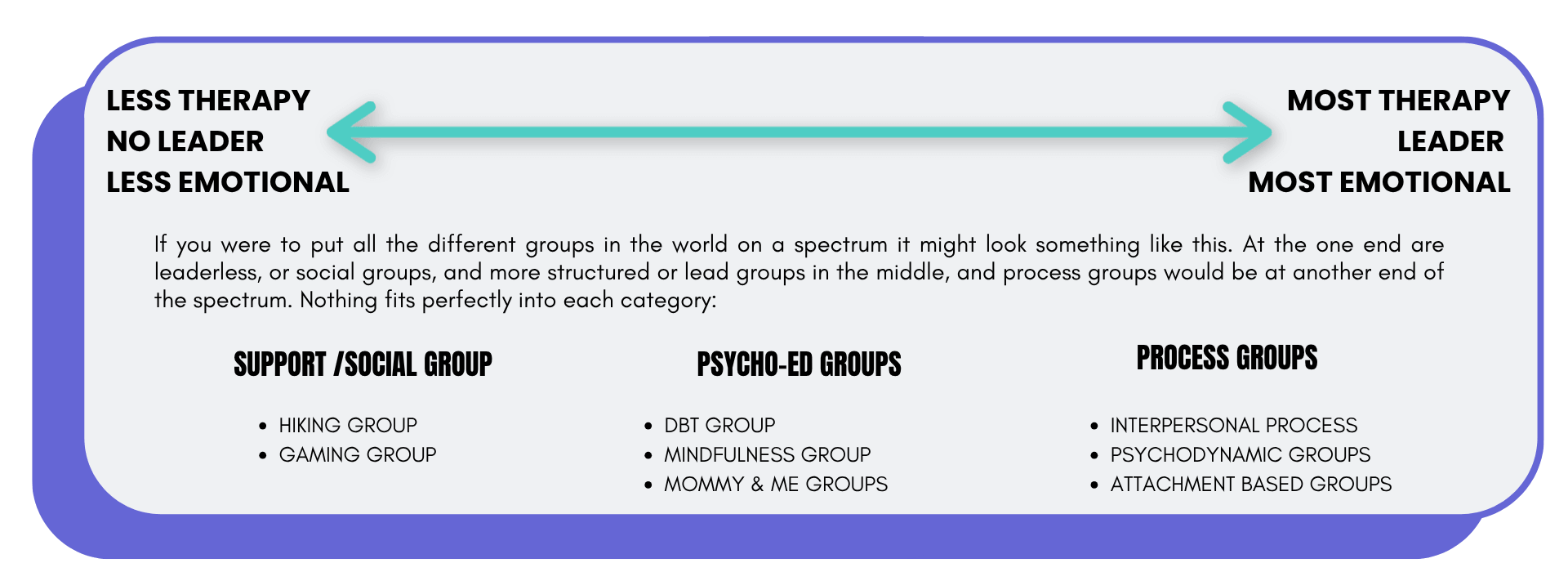
Think of group therapy on a spectrum. At one end you have a hiking group: therapeutic in its way, but no clinician involved. Move along the spectrum and you reach AA meetings, peer-led and structured around shared experience. Further still sit psychoeducational groups, DBT skills training, CBT groups, curriculum-driven sessions where learning is the point.
At the far end sits the interpersonal process group. Six to eight members, no curriculum, no homework. They meet to work on how they relate: to themselves, to each other, to people outside the room. Once you have those people in a room, getting them to talk in a way that helps them process feeling, deepen insight and create healthy connections is one of the more challenging therapeutic modalities.
In individual therapy, your warmth and unconditional positive regard lower a client's defenses. They feel safe, they open up, they do most of the talking. In a group, you are asking people to be vulnerable in front of strangers. The very thing that makes groups therapeutically powerful (the presence of other people) is also what makes them terrifying. Without specific group therapy techniques, sessions stall, members sit in silence, and the therapist ends up running what amounts to individual therapy with an audience.
Your job in a process group is not to treat each person one by one while others watch. It is to create conditions where genuine emotional exchange happens between members, in real time, in the room. That shift in focus, from therapist-to-member to member-to-member, is the foundation of every effective group therapy intervention covered below.
NEW: Here And Now Group Therapy Worksheets
You've heard of Yalom's Here and Now - but how do you actually use it in groups? Download the PDF and group therapy worksheets for an experiential activity I love to run in groups.
It helps change the norms of the group and opens up a conversation about emotional communication, intimacy and connections.
Comes with tracker sheets for the group, full description of the activity, printable questions and more.
Read More About It Here!
What Are the Most Effective Group Therapy Techniques for New Groups?
The most effective techniques for new group therapists who want to run process groups, in my optinion come from a school of thought called Modern Analytic Group Psychotherapy. It's a theory of techniques so is especially formulated to help bring about change in a group dynamic created by Louis R. Ormont, Ph.D. I've been fortunate to get some outstanding training from The Center For Group Studies in New York and love sharing what I've learned.
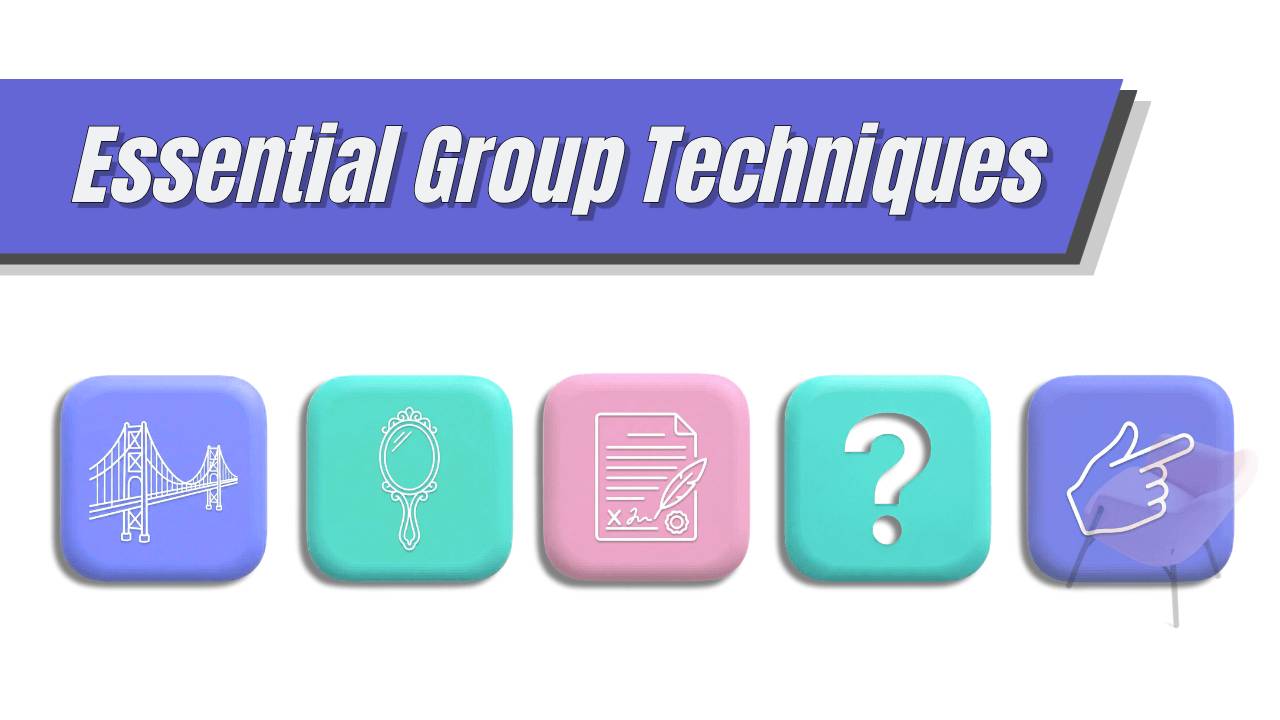
Modern Group Psychotherapy (MGP), built on the work of Hyman Spotnitz and expanded by Louis Ormont identifies seven distinct techniques designed to protect the ego while genuine therapeutic work unfolds. These aren't abstract principles, they're moves you can make in Monday's session.

Bridging As A Skill

Mirroring & Joining

Group Contract

Object Question

Contact Function
Looking For More Group Therapy Skills?
Join My Free Group Therapy Newsletter.
I send out a weekly free group therapy newsletter each week, and I'm determined to make it the most helpful email you get all week. I aim to make sure it's packed with how-to's, interventions, and a little bit of theory.
Click the image above or fill in the form below to sign up, it's totally free.
Get In On The Group Action!
A weekly free group therapy email for therapists new to group.
5 Essential Group Therapy Techniques (Quick Comparison)
Here are five or so of the most vital techniques I think are good to know from the start - if you read some of my blogs, or watch my YouTube, or better yet, join my newsletter where I share the most, you'll learn even more.
| Technique | Primary Goal | Best Used When | Clinical Outcome | Example |
|---|---|---|---|---|
| Joining | Reduce defensiveness | A member feels misunderstood or resistant | Builds safety and lowers opposition | “I can see why you'd want to pull back if this didn’t feel useful.” |
| Bridging | Increase cohesion | One person is carrying the emotional focus alone | Creates universality and shared engagement | “Does anyone else relate to what Marcus just described?” |
| Mirroring | Name defended emotion indirectly | A feeling is present but hard for the member to own | Supports emotional recognition without shame | “If I were in that seat, I might feel angry too.” |
| Object-Oriented Questions | Lower emotional pressure | The group is stuck or direct questions feel too intrusive | Restarts communication with less defensiveness | “What changed in the room just now?” |
| Tracking Contact Function | Support relational bids | A member reaches toward another person | Strengthens engagement and interpersonal learning | “You turned toward her when you said that—what were you hoping she’d hear?” |
What Is Bridging in Group Therapy?
Bridging is one of the foundational group therapy techniques for children, teens and adults. It’s the skill of actively connecting what one group member shares to the experiences, feelings, or themes present in another member — creating relational threads across the room. Rather than letting meaningful disclosures land and dissolve, a skilled therapist weaves them into the group fabric.

What Does Bridging Look Like As A Technique?
In practice, bridging sounds like: "What Marcus just described about feeling invisible — does that resonate with anyone else here?"
This technique carries particular value in group therapy techniques for schizophrenia populations, where members often struggle with interpersonal connection and may feel profoundly isolated even within a room full of people. Bridging gently externalizes that isolation without forcing vulnerability.
What bridging accomplishes:
- Reduces the "hot seat" dynamic where one person carries all the emotional weight
- Builds universality — a core therapeutic factor in group work
-
Activates the group as the agent of change, not just the therapist
Cohesion deepens not when members share the same story, but when they recognize the same feeling wearing a different face.
Bridging keeps the group alive between disclosures. Of course, knowing when to bridge and when to let silence breathe is a skill — and it becomes even more complex when one voice is consistently drowning out the others.

What Is Mirroring As A Group Counseling Technique?
Mirroring is not repeating back what someone said. In modern group analysis, mirroring means accepting a member's defenses as though they were your own and attributing the unconscious impulses being defended against to yourself. You take what the member cannot tolerate feeling and hold it out loud, as if it belongs to you.
What Does Mirroring Look Like As A Technique?
In practice, mirroring sounds like: "I think if I were sitting where Ken is, I'd be furious right now. I don't know if that's true for him, but it would be true for me."
This technique works precisely because it removes the accusatory structure of most feedback. The member hears their unspoken feeling named aloud without being told they're feeling it. That distinction matters enormously for members whose early relational experiences taught them that being seen meant being attacked.
What mirroring accomplishes:
- Gives voice to feelings the member is defending against without requiring them to own those feelings yet
- Models emotional honesty from the therapist, which the group gradually internalizes
-
Reduces the risk of a negative therapeutic reaction, where an accurate interpretation destabilizes rather than helps
The trap with mirroring is performing it as a formulaic "I-statement" exercise. Real mirroring requires the therapist to feel something first. You aren't constructing a clever reframe. You're letting the member's emotional state land in you and then speaking from that place, with your own vulnerability on display.
Mirroring names what the room already feels. The next question is how to tell when a member is ready to receive it, and that's where reading the contact function becomes your most reliable signal.
What Is the Group Agreement & Why It's My Core Technique
Most therapists treat the group agreement as paperwork. They cover it in the first session, file it away, and never touch it again. Then someone shows up late three weeks running, or a member starts dominating every session, and the therapist has no clinical frame to work with.
That is the problem the group agreement is designed to solve — but only if you understand what it actually is.

How Does The Group Agreement Help As A Group Therapy Technique?
The group agreement is not a set of rules. It is a diagnostic instrument. Every breach of the contract, the late arrivals, the missed payments, the member who never takes their share of the time, is showing you something about that person's relational world that they cannot yet put into words. The agreement creates the conditions under which those patterns become visible. Without it, you are just watching behaviour. With it, you have clinical material.
What the group agreement accomplishes in group counseling.:
-
Provides a frame that makes breaches legible as communication rather than misbehavior, turning every late arrival, silence, and interruption into clinical material
-
Gives the therapist explicit permission to inquire, redirect, and explore without having to justify the intervention in the moment
-
Expands the self: when members do articulate their thoughts and feelings per the agreement, the act itself builds self-definition, legitimacy, and affect regulation
A well-built agreement covers the basics: consistent attendance, confidentiality, putting feelings into words rather than actions, sharing airtime, and bringing reactions to what happens in the room into the room. Those sound like housekeeping. They function as clinical windows into each member's relational patterns.
The harder skill is knowing what to do when the agreement gets broken — and that is where most group therapy training leaves clinicians without a map.

How Does the Contact Function Help Run Your Group?
The contact function describes a member's capacity to perceive another person, reach out, and establish a relationship. It shows up as any verbal or nonverbal bid to prompt another person to engage. When Ken turns to Barbie mid-session and says "What do you think about that?", that's a contact function. When Nikki shifts her chair slightly toward the circle after weeks of sitting back, that counts too.
Contact functioning is one of the most subtle group therapy techniques because it requires you to track something most clinicians weren't trained to notice. The member who makes a bid for connection is signaling readiness. Following that bid returns agency to the member. Ignoring it, or redirecting the group before the bid lands pulls agency back to the therapist.
What tracking the contact function accomplishes:
-
Lets the member set the pace of their own engagement rather than having the therapist push them forward
-
Provides live assessment data: a member's answer quality (concrete, vague, self-referential, silent) reveals their relational capacity in that moment
-
Builds the group's own bridging skills over time as members learn to follow each other's bids without therapist prompting
There's a paradox here. Contact can interrupt a deeper disclosure while still signaling growth. A member who cuts into someone's story with an unrelated comment might be disrupting the process or might be making their first genuine attempt to connect in six months. The clinical skill is reading which one it is.
Contact bids tell you who's ready. But what about the member who never makes one? That's when you need a question format designed to protect the ego while still opening the door.

How Do Object-Oriented Questions Help In Group Counseling?
An object-oriented question asks about external people, events, or concrete details instead of going straight at the exposed inner self. It drops the "you" entirely. Instead of "Why did you react that way?", the question becomes "Where did that come from?" or "What was happening around you when that feeling showed up?"
Keep reading for my prime example from personal experience.
This is one of the most deployable group therapy techniques across clinical settings. I use it in private practice, couples work, family sessions, process groups. The object-oriented question protects both the speaker and the listener from ego attack. Third-person framing stirs curiosity without triggering a defensive response, and the answers often come with more emotional honesty than a direct "how did that make you feel?" would.
What object-oriented questions accomplish:
- Restart communication in stuck moments by lowering the emotional temperature just enough for someone to speak.
- Reveal resistance patterns through the form of the answer, not just the content (vague answers, topic changes, and silence all carry clinical meaning)
- Support growth without requiring members to perform vulnerabilities they aren't ready for
The key rule is relevance over cleverness. A well-timed object-oriented question is organically linked to what the member just said, not a clever redirect to where you want the group to go. If the question feels like a therapist move, it probably is one, and the group will feel it.
Object-oriented questions protect the member's ego from the outside.

More Group Counseling?
I have a mini group therapy training course available on YouTube for free that covers some of the ways I think about group counseling techniques and skills - start with this one and work your way through other concepts.
Group Therapy Techniques FAQs
What makes group therapy techniques different from individual therapy techniques?
Group techniques leverage the relational field itself — the interactions between members — as the primary vehicle for change. Individual therapy focuses on one therapeutic relationship; group work multiplies that dynamic exponentially.
How many members should a therapy group have?
Most clinicians consider five to ten members the optimal range. Fewer limits interpersonal variety; more makes it difficult to give each member meaningful airtime.
Do these techniques work across different group formats?
In practice, the core principles adapt across psychoeducational, process, and support groups — though the specific application shifts depending on the group's goals and structure. That flexibility is part of what makes group counseling techniques so worth mastering deeply.
What Are the Methods of Group Therapies?
Group therapy isn't a single approach — it's a broad framework that draws from several distinct methods. The core categories include psychoeducational groups (teaching skills and information), process-oriented groups (exploring interpersonal dynamics in real time), support groups (fostering shared experience and belonging), and skills-based groups (practicing specific behavioral strategies together). Each method serves a different clinical purpose, and skilled facilitators often blend more than one. That natural overlap between methods is exactly what makes the next topic — cognitive behavioral therapy in groups — such a powerful tool to explore.
The Benefits of Group Therapy
According to a 2023 American Psychological Association review, group therapy is as effective as individual therapy across 329 clinical trials covering eleven categories of mental health conditions. That includes anxiety, depression, PTSD, and substance use disorders.
The effectiveness of group therapy is not despite the presence of other people. It is because of it.
There are things a well-run group can do that no individual therapeutic relationship can replicate. Members receive feedback from peers, not just from a clinician. They witness each other's patterns in real time, without the filter of a self-report. The member who insists he never creates the situations he complains about will, sooner or later, create one in front of six people who watched the whole setup unfold. Individual therapy can take years to surface what a group surfaces in twenty minutes.
The curative factors Yalom identified, universality, cohesion, interpersonal learning, instillation of hope, are not soft benefits. Cohesion, the sense that this group is a place worth investing in, is roughly equivalent to the therapeutic alliance in individual work. The AGPA's evidence-based practice guidelines confirm a strong research base across presentations. Groups are also more cost-effective: multiple people benefit from the same clinical hour.
As a licensed marriage and family therapist and certified group psychotherapist, I've run process groups for over a decade. The research matches the clinical experience: when a group is working, it is the most efficient change process in our field.
Other Types Of Group Therapy
Interpersonal process groups are one end of a broad spectrum.
Psychoeducational groups, including cognitive-behavioral group therapy (CBGT) and dialectical behavior therapy (DBT) skills groups, are structured around a curriculum. Members come to learn specific evidence-based skills: distress tolerance, emotion regulation, cognitive restructuring. The therapist functions more as educator than facilitator, and there is usually homework.
Acceptance and Commitment Therapy (ACT) groups and interpersonal psychotherapy (IPT) groups sit between the structured and the unstructured. They use the group setting to practice specific frameworks while leaving some room for relational work.
Support groups, whether peer-led like AA or professionally run grief or addiction groups, prioritize shared experience, universality, and mutual support over in-depth clinical processing.
Trauma-informed group therapy applies trauma-sensitive principles across these formats, adjusting pacing and safety structures for populations where the window of tolerance is narrower.
The interpersonal process group at the far end of the spectrum is the one where all five interventions above apply. There is no curriculum, no homework, no agenda. The group's relationships are the treatment. Everything that matters is happening in the room.
Oliver's Final Thoughts
Running a process group well is a specific skill set, and most training programs under-prepare clinicians for it. The five interventions above, the group agreement as a live clinical tool, bridging, progressive emotional communication, immediacy, and countertransference, are not optional extras. They are the mechanism. Without them, a group stays at the surface.
The My People Patterns newsletter covers these frameworks in depth, written for licensed practitioners and trainees who want to be smarter in the room.
