
How To Run A Group Therapy Session - My Top Skills
By Oliver Drakeford, Certified Group Psychotherapist.
I ran my first group therapy session more than ten years ago, and I still remember how anxious I felt—my hands are getting clammy just thinking about it! In this post, I’ll share some skills and tools that have helped me, along with tips for finding more training and support. Some of these resources are even free!
Whenever I teach group process or run a training group, I'm always curious to know what peoples experience in grad school was, and most people I speak to had a very limited class, and even more surprising, there was no demonstration group in which students participate in. Group therapy is best learned by actually being in a group, so I encourage you to experience this by exploring AGPA and your local chapter. Failing that, find out more by joining my free weekly group therapy newsletter, the details are below.
My Top Skills To Run A Group Therapy Session
Here's what's covered in this article, and click the images below to jump ahead:

The Here-And-Now: Using What's In The Room

Follow the Emotional Thread, Not The Content

How To Get the Group Talking to Each Other, Not You!

The Group Agreement Is Core Of Group Processing
What Is A Process Group?
I define a process group as consisting of six to eight people who meet regularly with the goal of enhancing relationships with others, understanding themselves and to live a satisfying or fulfilling life. Group therapy helps members understand and overcome the blocks that prevent this from happening.
How Is An Interpersonal Process Group Different?
An interpersonal process group is different from a skills based group, a support group or educational group in that there's no theme, topic or activity. Instead, members show up and talk. It sounds like that should be straight forward and easy to achieve but human psychology is much more nuanced whenever relationships are involved.
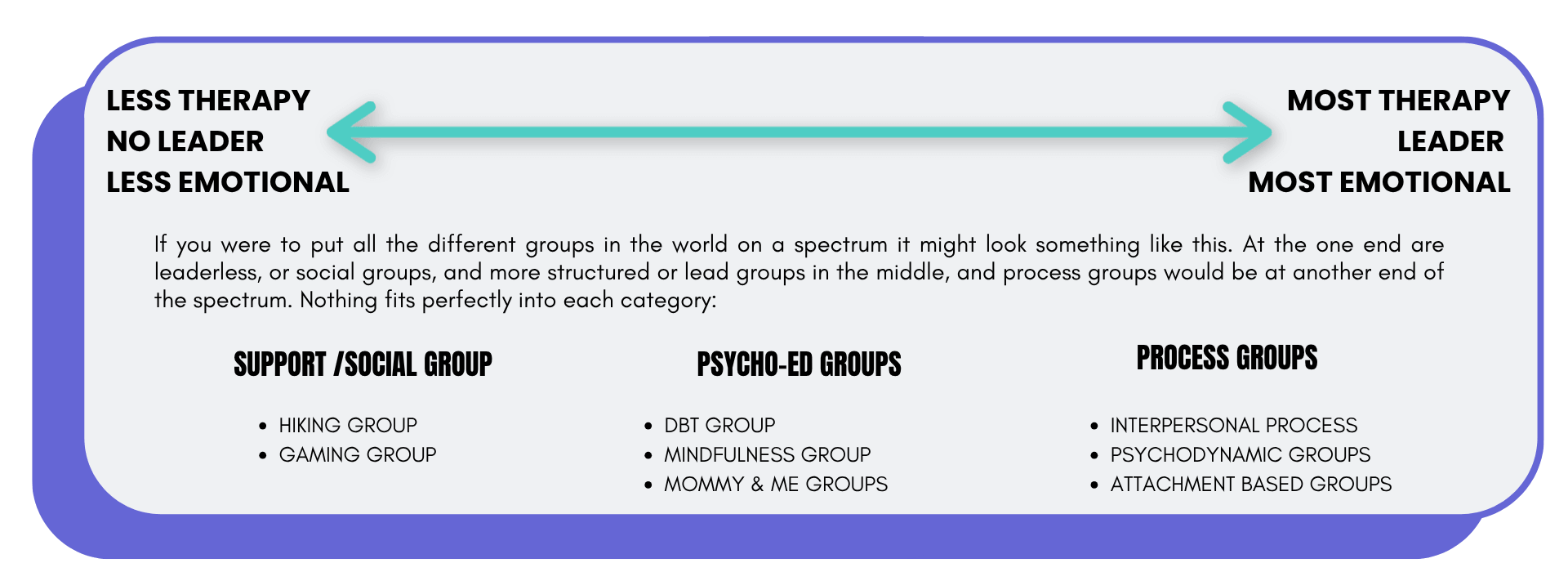
Process groups are different from most other types of groups, and understanding those differences is key when learning how group therapy works. One way to think about it is as a continuum.

On one side are informal or social groups — the kinds of groups people join for shared interests, networking, or community activities. These groups may have little structure and often focus more on participation or social connection than emotional insight.
Moving further along the spectrum are structured psychoeducational or skills-based groups. These groups usually have a facilitator, a defined purpose, and clear goals or teaching objectives. Parenting groups, support groups, and educational therapy groups often fall into this category because they focus on learning, coping strategies, or behavioral change.
Interpersonal Group Process Is Different:
At the opposite end are interpersonal process groups, which place primary attention on the relationships and emotional exchanges happening between members in real time. If you're asking, “What is group process?” the answer lies in these moment-to-moment interactions. Group process refers to the way members communicate, respond, attach, avoid, confront, support, or influence one another within the group environment.
Rather than focusing mainly on advice, instruction, or problem-solving, process-oriented group therapy emphasizes self-awareness, emotional expression, interpersonal feedback, and relational patterns. Members are encouraged to notice how they affect others, how others affect them, and what these dynamics may reveal about their relationships outside the group. The group itself becomes a living social system where patterns of communication, vulnerability, conflict, trust, and connection can be explored in depth.
Because of this, process groups often create powerful opportunities for insight, emotional growth, and corrective relational experiences that extend beyond the therapy room.
The Legal & Ethical Ground Rules Of Group
Goals and Objectives Of Process Groups
How to Structure A Group Session
The mistake almost every new group therapist makes
There's a big temptation for new group therapists to open their first session with some version of "Who wants to begin?"
It feels neutral, it's inviting, and open. But that opening communicates something specific to the group, that has the potential to be problematic. Essentially it conveys the idea that someone needs to bring you a problem to work on together. It sets the stage for one of two things:
Either group becomes a seminar with feelings or classroom, or it sets you up to do one-on-one therapy with an audience. Read more about group therapy techniques here.

So the first move in learning how to run a group therapy session is recognizing the pull toward the classroom and choosing something else. The skills below are a start to understanding how to do that, and if you're curious, you might have noticed that I have a weekly group therapy newsletter that I'd love for you to join, it's free and I try and make it the most helpful email you get all week.
How the Group Agreement Creates The Group Process
What the Group Is Actually Doing: Group Process
Progressive emotional communication is the engine of an interpersonal process group, and it sounds more complicated than it is. Our goal as group therapists is to help group gradually talk more freely about what they actually feel, including, and especially, what they feel toward each other.
Early on, members talk around those feelings: they tell stories about people who aren't in the room, they give advice, they intellectualize, they laugh things off. All of that is communication too, but it's also a defense against sharing what they feel.
As the group develops, as trust builds and the frame holds, we have to help members start to bringing their reactions into the room directly.
One of the ways I think about progressive emotional communication is along the lines of 'Differentiation of Self' - just to confuse you with theories, but it makes sense in my mind.

Progressive emotional communication helps clients communicate feelings directly, instead of thoughts. It also encourages us to explore feelings that go towards others.
- Feelings: “I feel disappointed.”
- Thoughts Disguised As Feelings: “I feel that the writing was on the wall.”
- Self-Oriented Feelings: “I felt scared when you yelled.”
- Object-Oriented Feelings: “I felt scared when you yelled, and feel angry towards you for yelling.”
The Focus On The Here-And-Now
The emotional thread in a group is whatever feelings are alive in the room right now, which is very different from the story someone brought about what happened last Tuesday.
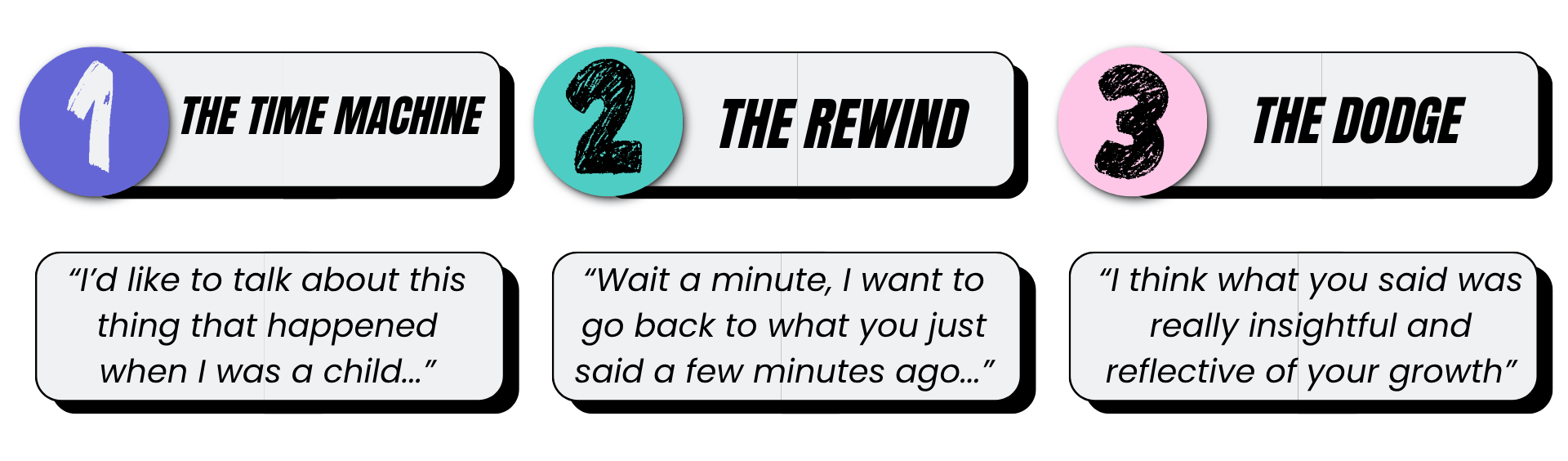
That doesn't mean that we stop people from talking about that thing that happened last week, or in their childhoods, but we do need to know how to process what's in the room. The clinical opportunity is in the reactions that are happening in other people, perhaps literally, on someone's face across the circle, or in the silence that falls when someone stops talking about a long and detailed story about their stamp collection.
It's incredibly hard to talk about your feelings directly with a group of strangers, and we've unconsciously developed strategies or defenses to avoid doing this. Part of the work in group therapy is to spot these strategies in action and gently nudge people to focus on what they are feeling now.
Take a look at some of these example and if you recognize any of them join the newsletter - I talk about things like this, and what to do each week.
Bridging Is Your New Core Group Therapy Skill
A member says something, the therapist responds, another member says something, the therapist responds again, and without anyone deciding to do it the room has turned into eight separate one-on-one conversations happening in front of an audience.
Bridging is the intervention that breaks that pattern.
- Instead of responding to what someone said, I'll ask a group member to share what they thought or felt.
- I create a bridge between person A and person B to connect.
- Instead of interpreting what just happened between two members, I ask a third member what they noticed, what they felt, whether any of it landed somewhere familiar.
- I create a bridge between person C and person A and person B
The idea is to build direct emotional contact between members, because that contact, the live experience of feeling seen or misunderstood or surprisingly moved by someone sitting across the circle, is where the therapeutic work actually happens. Over time the group learns that this is what is being encouraged and they'll see that meaningful moments happen without you doing the heavy lifting for the entire session.

Group Therapy H.I.T
I send out a weekly free group therapy email that helps newer group therapists understand more about the skills, tools and techniques that grad school might have skipped over.
It's totally free and you can unsubscribe at any time!
Group Therapy HIT: Skills Tools and More:
A weekly free group therapy newsletter for new group therapists.
The Stages of Group Development
Storming
Norming
Performing
Adjourning
Frequently Asked Questions
What is the difference between a process group and a support group?
A support group usually has a theme, a topic, or a shared experience that brings people together, and the focus tends to be on mutual encouragement around that thing. A process group has none of that. Members show up, and whatever happens between them in the room becomes the material. The goal isn't to support each other through a shared problem, it's to understand how each person relates to other people, using the relationships forming right there in the group to do it.
How do you lead a process group without an agenda?
This is the question that trips up most new group therapists, because training tends to teach us that good clinical work means coming prepared. In a process group, the preparation is in your understanding of what to do with whatever shows up, not in having a plan for what should show up. Your job is to follow the emotional thread, notice what the group is avoiding, and use bridging to create direct contact between members. The group brings the agenda, even when it looks like it hasn't.
How many people should be in a group therapy session?
For an interpersonal process group, six to eight members tends to be the sweet spot. Fewer than that and the group doesn't have enough relational complexity to work with. More than eight and it becomes difficult for quieter members to find their way in, and the therapist starts to lose track of the emotional threads running between people. That range gives you enough diversity of reaction while keeping the room small enough to feel safe.
What should a therapist do when a group goes silent?
Sit with it longer than feels comfortable, for a start. Silence in a group is almost never nothing. It's usually anger, or anxiety, or the whole group collectively holding its breath around something that just happened and nobody is ready to name yet. The question worth asking yourself in that moment is not how to fill the silence, but what the silence might be saying on behalf of the group. Sometimes the most useful thing is to name it: "I notice we've all gone quiet."
Do you need special training to run a group therapy session?
Running a group well is a genuinely different skill set from individual therapy, and most graduate programs give it very little time. The relational complexity is higher, the interventions are different, and the therapist's use of self in a group context takes specific experience to develop. AGPA, the American Group Psychotherapy Association, is the best place to start if you want proper training, and getting into a group yourself as a participant, before or alongside running one, will teach you more than any course on its own.
