
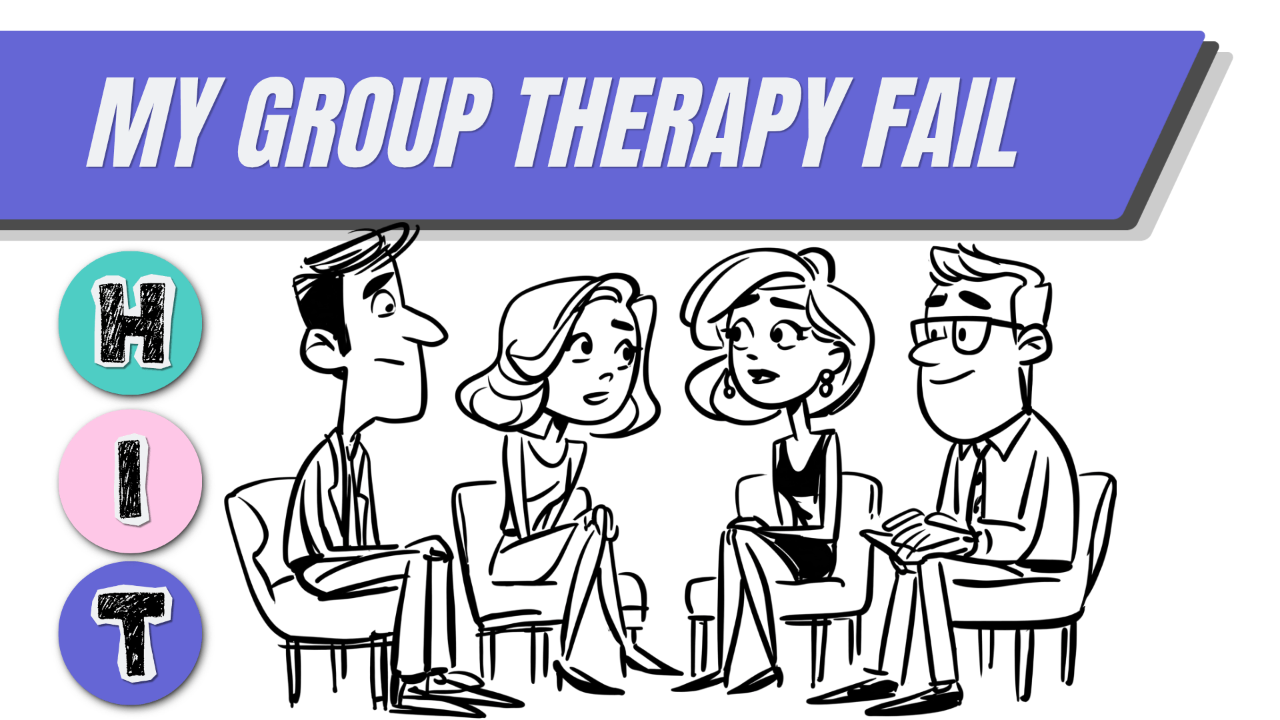
When you’re a group therapist, you’re often faced with eight people sitting in a room who joined the group to connect with others, and yet, in the first few sessions, sit awrkwardly staring at you with expectations that you’ll magically do it for them.
They’re in the room but not really talking, and definitely not connecting.
The real issue isn’t disengagement, it’s the absence of connection. Though they sit close, they remain clinical strangers, hiding their private worlds behind polite listening faces, waiting for you to help them connect.
This is where bridging comes in: one of the essential techniques of Modern Analytic Therapy and one of the most practical group therapy skills.
Let's look at what bridging actually is, when to use it, how to do it well, and some common mistakes.
What Bridging Actually Is (and What It’s Not)
Bridging is a process specific to group therapy. Unlike encouraging members to speak based on commonalities or backgrounds, as one might at a corporate event or party. In group therapy, we distinguish between bridging as an intervention that serves the deeper purpose of group connection, rather than surface-level socializing.
When you connect people through common interests or backgrounds, you set the terms of the conversation, which isn't unhelpful, but it can lead to a lot of small talk, which is not the point of group therapy.
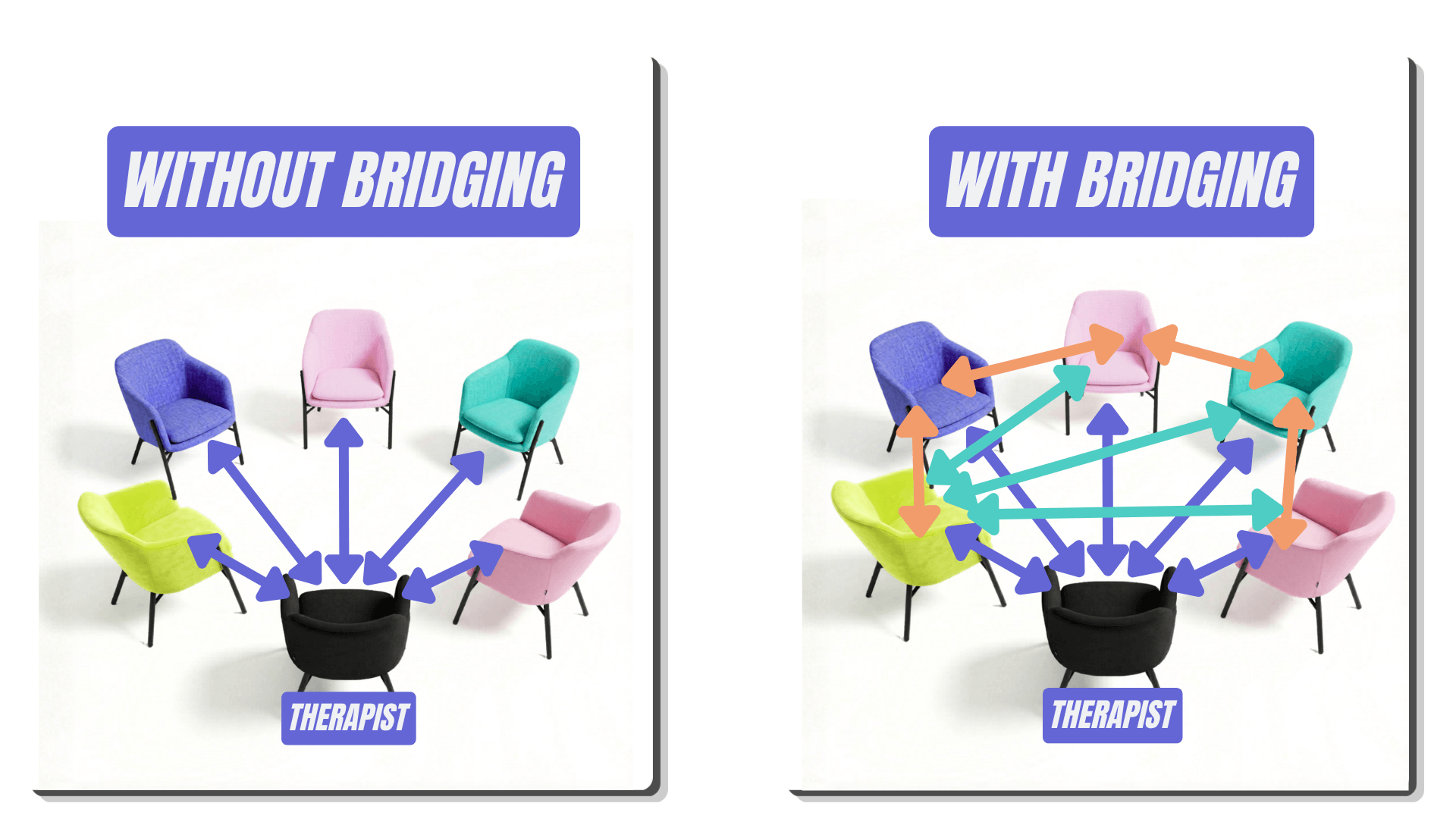
When done correctly, bridging in group therapy means facilitating an authentic, meaningful connection among group members. This involves inviting one person to share something vulnerably about themselves or what they’re feeling in the moment, and then encouraging another member to respond from their own perspective.
Bridging helps connect people by identifying similarities and creates space for different feelings and thoughts to be expressed and understood by others in the group. The goal is to encourage exchange that leads to genuine awareness.
This is the group leader’s main skill: a therapist can’t carry a group alone; we have to enable the group to be more spontaneous and alive to be successful. When members start talking to each other about what really matters, the group begins to help itself. Your role is to create the connection, then step back.
Five Moments When You Need to Bridge
So I want to give you something you can actually use in session. A way to assess the room and know when it's time to bridge, and that being said, you are able to bridge any time, but these instances in particular are a must!
I call it S.C.A.N. It’s four signals that tell you the group needs you to step in and connect people.
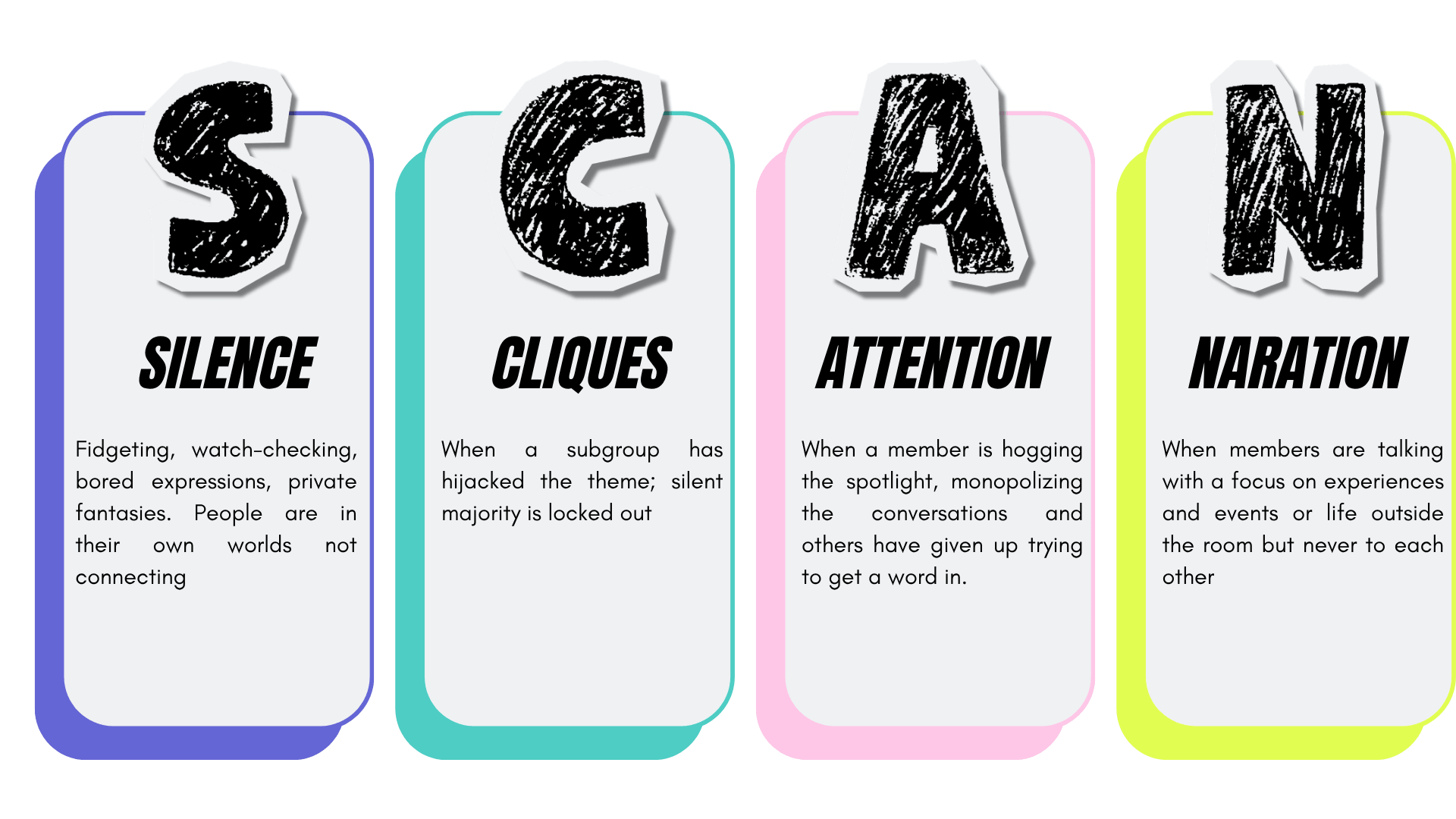
S is for Silence spreading. This is the one you feel in your body before you see it. The group goes quiet. Not the productive kind of quiet where someone just said something real and everyone's sitting with it. This is the dead kind. Ken's checking his watch. Barbie's staring at the ceiling. Jimmy's drifting off into his own head.
And you're sitting there thinking about what you’re going to have for dinner. And if you're thinking that, I promise you they're thinking it too. That silence isn't neutral. It's usually anger or fear, and if you leave it too long, people start making plans to quit.
C is for Clique controlling. This is when a subgroup takes over the room. Let's say you've got four members who've decided that the theme of every session is their difficult marriages.
And the other people in the group have just about stopped trying. They sit there like an audience watching a show they didn't buy tickets for. The clique doesn't even realize they're doing it because to them, it feels like productive work. But the silent majority is losing its viewpoint, and if you don't catch it, you'll lose them.
A is for Attention hoarding. You know this person. Every sentence opens with "I." "My boss ignores me." "My wife doesn't listen." "My mother was the same." And here's the thing: while they're complaining that nobody pays attention to them, they're monopolizing the total attention of everyone in the room.
The other members get the message after a while. They give up. So you've got one person talking, and six people checked out, and it looks like a group, but it's actually one person doing individual therapy with an audience. Which is my pet peeve, as you know.
N is for Narrating. This one's sneaky because it can look like the group is working. People are talking. There are words happening. But listen to what they're actually doing. They're reporting. They're telling stories about their week, about their partner, about their boss.
They're talking about life outside the room, but they're not talking to each other. There's no emotional contact between the members. It's like six separate therapy sessions happening in parallel, and nobody's in the same room. The energy's going out the window instead of bouncing back and forth between people.
|
Let me know in the comments if you have questions about bridging or ideas for a future emails!
Take care, Oliver & My People Patterns.


Responses