
Paradoxical Interventions in Family Therapy
Sep 30, 2026
Paradoxical Interventions in Family Therapy
A practical guide for clinicians
By Oliver Drakeford, LMFT, CGP | My People Patterns

Paradoxical interventions in family therapy deliberately take a position that seems to oppose the stated treatment goal. A therapist may invite a client to continue or schedule an agreed aspect of a problem, with the aim of changing their response to it.
That can sound rather odd when you first meet the idea. Families usually arrive wanting fewer symptoms. Why would a therapist invite more of anything?
The answer depends on what keeps happening around the problem.
A useful paradox grows out of a working hypothesis about that pattern. Without one, the therapist is guessing with unusual instructions. So in this post and the video I'll explain how to think about these types of interventions and how you use them.
For more reading:
- My newsletter issue that tackles this problem : Paradoxical Interventions - The PDF Free Guide
- This page for more PDF's and worksheets: Family Therapy Worksheets and PDF's
- The home page for all things Structural Family Systems Theory.
What makes an intervention paradoxical
A paradoxical directive is a therapeutic instruction that appears to run against the agreed goal. Its purpose is to change how people respond to the problem, sometimes by interrupting their usual attempts to solve it.
In symptom prescription, the therapist asks the client to deliberately produce or schedule an agreed aspect of the difficulty. Other paradoxical approaches may ask a family to slow a change they have been pushing for, or reconsider the possible consequences of giving up a familiar pattern.
The wording alone tells us very little. Asking a family to pause an argument could be straightforward support. Asking them to maintain a safe, agreed element of a pattern, because that changes their relationship to it, may have a paradoxical rationale.
I would want to explain what I expect the instruction to change. Which response might become less automatic? What would the family do differently? If I cannot answer those questions, I need a better formulation before another technique.
Where paradox fits in strategic family therapy
Strategic family therapy uses planned interventions to change patterns that maintain a presenting problem. Paradoxical directives belong within that tradition, although strategic therapists also use direct tasks. A direct task asks the family to practice the desired change.
The therapist looks at the sequence surrounding a difficulty. What happens just before it? How does each person respond? What happens next that makes the same sequence more likely to repeat?
Bogdan's 1982 theoretical account of paradoxical interventions offers one explanation of their logic. It is a conceptual paper, rather than evidence that a particular directive will work with the family in your room.
My starting point is often structural family therapy. That means looking at how a family organizes its relationships and responsibilities. Who steps in when someone becomes distressed? Who gets left outside? Who carries decisions that should belong to an adult?
A structural family map can help make those observations clearer. Structural assessment and strategic task design can inform each other, but they answer different questions. The map helps describe the family's organization. The directive tests a proposed way of changing an interaction.
Prescribing the symptom and changing its context
Worry time is an example I discuss in my teaching. At an agreed time, a client gives attention to worries instead of spending the whole day trying to force them away.
Scheduling worry can have different rationales. The Centre for Clinical Interventions teaches worry postponement, which lets people leave aside worries that no longer concern them. In a paradoxical prescription, the instruction deliberately invites an agreed aspect of the difficulty. The treatment's explanation and goal matter more than the task's name.
This distinction also applies to family work. A therapist taking responsibility for pausing a difficult conversation may be changing the conditions around a symptom. Calling a pause is not, by itself, a prescription to have that symptom.
In the family example from my teaching, the useful question is what happens when emotional conversations stop. If stopping brings relief, we can explore safer ways to manage the conversation. We do not have to assume that someone deliberately caused a symptom to obtain that relief.
That gives us a more precise question: could the family learn to ask for a pause, and then return to the conversation with support?
Assess the pattern before choosing the task
Before deciding whether a paradox belongs in the work, describe one repeated interaction in ordinary language. Include your own part in it.
For instance, does the therapist keep pressing for a conversation while a family member becomes less able or willing to participate? Increasing the pressure may be part of the sequence you need to understand.
Then test your explanation with the family. Circular questioning, which asks people about each other's responses and relationships, can help. You might ask who notices the tension first, or what another person does when the conversation stops.
Keep an observation separate from an interpretation. You may observe that a symptom is followed by less conflict. Saying that the symptom exists to prevent conflict is a hypothesis. Saying that the person produces it deliberately is a further claim requiring separate evidence.
Several explanations can fit the same sequence. Fear, exhaustion, or a lack of trust may affect participation. Check whether the family understands the task and whether the conversation feels safe enough to attempt.
Working with cooperation and pushback
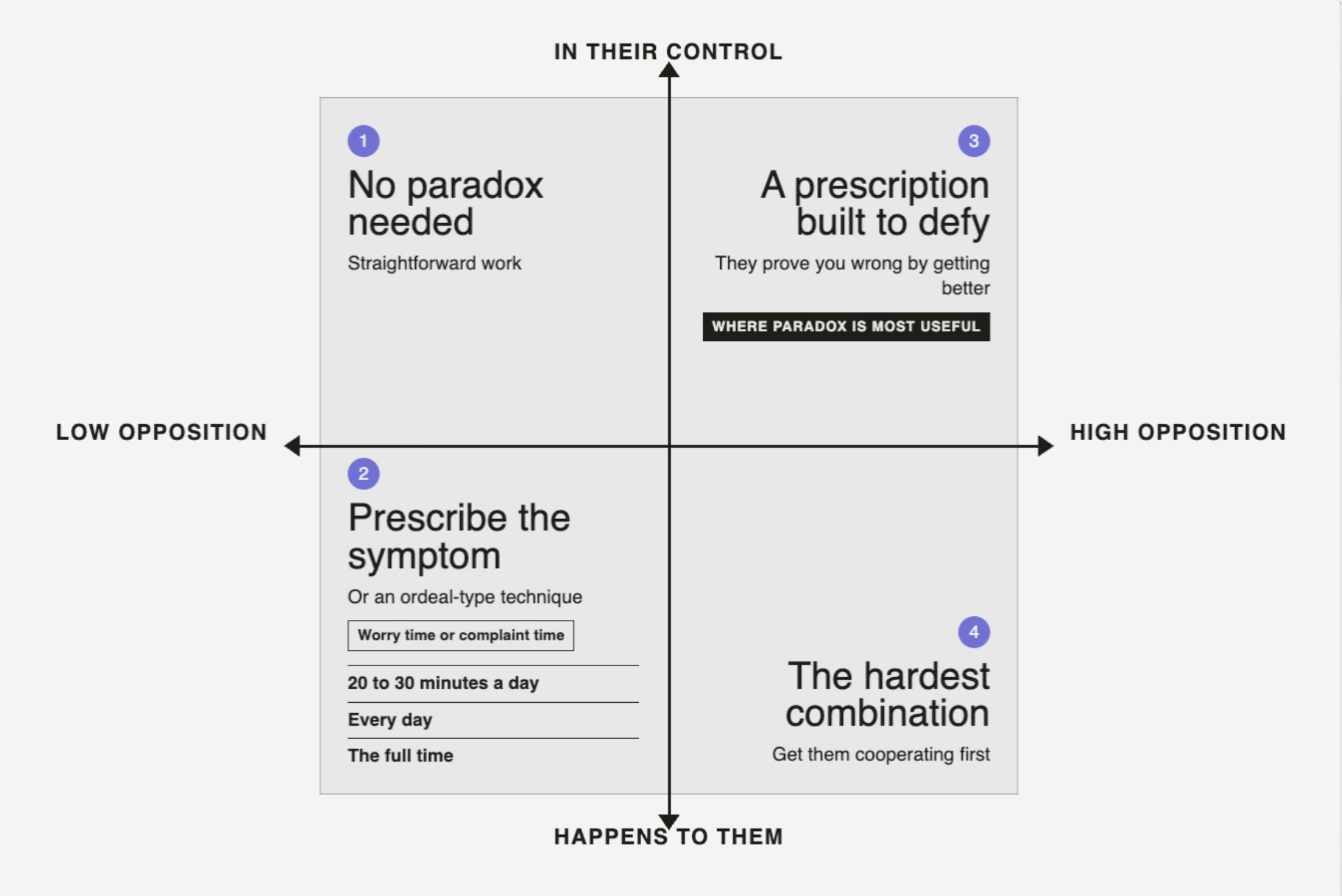
In my teaching, I use two questions to think about a stuck session
- How much is the client pushing against the proposed therapy?
- Does the client experience the symptom as something they can influence, or something that happens to them?
I rather like a two by two grid. It makes a complicated conversation easier to think about. Here, it is a teaching aid. It does not establish a diagnosis or determine which intervention is safe.
A person may want help while finding a particular conversation intolerable. They may disagree with the therapist's explanation and still be willing to work. These differences matter when we use a broad word such as resistance.
Some paradoxical approaches anticipate cooperation. The client follows the task, and the changed context may alter their experience of the problem. Others anticipate defiance. The therapist proposes something the client is expected to reject, with rejection intended to move them toward change. Rohrbaugh and colleagues described these two pathways in their 1981 theoretical paper.
That second approach requires particular care. A client who feels cornered may leave, become more distressed, or stop telling you what is happening. Disagreement gives you information about the work. It does not guarantee that the person can switch off a symptom to prove you wrong.
For the original grid and family formulation, see my archived newsletter on paradoxical interventions. Read the vignette as a discussion of clinical hypotheses, with the assessment limits described here in mind.
When to slow down or choose another approach
Paradox needs a clear treatment rationale and appropriate training. It also needs informed consent that the family can understand. The AAMFT Code of Ethics addresses consent, client autonomy, and practicing within competence. Those duties apply when a task is clever, too.
Check these limits before proceeding:
Do not prescribe dangerous behavior, self-harm, abuse, or a medically risky symptom. Assess the risk and arrange the care required.
Do not interpret unexplained physical symptoms as proof of deception. Medical assessment and a relational formulation can both be needed.
If someone fears another family member, assess safety and coercion before asking them to participate in a shared task.
Explain the proposed task, its purpose and risks. Make room for questions and refusal without punishment.
Seek supervision when the rationale depends on provoking a client or on assumptions about their control of symptoms.
With young people, the adults' authority needs particular attention. A task can feel very different when the person proposing it also influences discharge or family contact. Avoid making treatment into a contest the young person has to lose.
Normal investigations alone do not establish that symptoms are voluntary. The NHS guidance on medically unexplained symptoms explains that physical symptoms can be genuine even when their cause has not been identified. Observing family interactions cannot settle a medical diagnosis.
Often, a direct intervention is easier to explain and evaluate. That might mean agreeing how to request a pause or changing who carries responsibility during a difficult conversation. A family does not need a paradox simply because the therapist feels stuck.
How to evaluate the response
Agree what you are looking for before the task begins. A change should be observable and connected to the family's goal.
Perhaps family members can now request a pause and return to a conversation. Perhaps they can disagree without one person having to manage everyone's distress. Ask each participant how they experienced the task, including whether they felt pressured or misunderstood.
Track the presenting problem as well. Less visible conflict in the room does not tell you whether distress has reduced at home.
If the task increases fear or damages trust, stop and reassess. If nothing changes, revisit the formulation. The family's response can tell you that the task was poorly timed or that your explanation missed something.
Build the formulation first
The part I find most useful is the thinking before the directive. What happens around the symptom? What does the family currently do when tension rises? What support would make another response possible?
That is the work behind choosing an intervention with a reason. If you want help developing those skills, Family Systems Step by Step covers structural assessment, family mapping and the development of a working hypothesis, then connects that thinking to interventions.
You can also watch the original paradoxical interventions video alongside the archived newsletter. Bring a formulation to supervision before borrowing a directive. You will have a much better conversation about whether it fits.
