

When I worked in residential treatment, a good number of teens did not want to be there and would corner me to explain, at volume, why they needed to go home today. When they failed to convince me, they’d call their parents, and I heard tears, threats, bargaining, and a few very creative bribes.
In the end, I was able to get them to stay by giving them the opportunity to prove me wrong- and that is what makes up a paradoxical intervention.

Most writing about paradoxical interventions is a definition and a few examples, which only takes you so far when you're stuck with a family that isn’t changing the way you’d hope.
In the video below, I show you the four-box grid I use to decide if using a paradoxical intervention fits, and how to think about it when it does. This issue is all about one of those boxes in which a client has some fairly strong resistance to therapy (or you) and is in control of their symptoms - it’s a behavior they chose to do.
The free PDF you can get at the bottom of this email gives you several examples I pulled from various sources - I’ve found that reading about how other therapists use them makes it click for me.
BLATANT SELF-PROMOTION
|
RECAP: THE FOLLOW-OR-FIGHT GRID
This was inspired by a case presentation from a therapist in my consultation group who presented a family with a level of stuckness that I thought called for a paradoxical intervention. Before choosing a paradoxical intervention, we sort the client using two questions:
- Opposition: How hard is this client pushing against therapy and against you?
- Control: Does the symptom feel to them like something they're doing, or like something that happens to them?
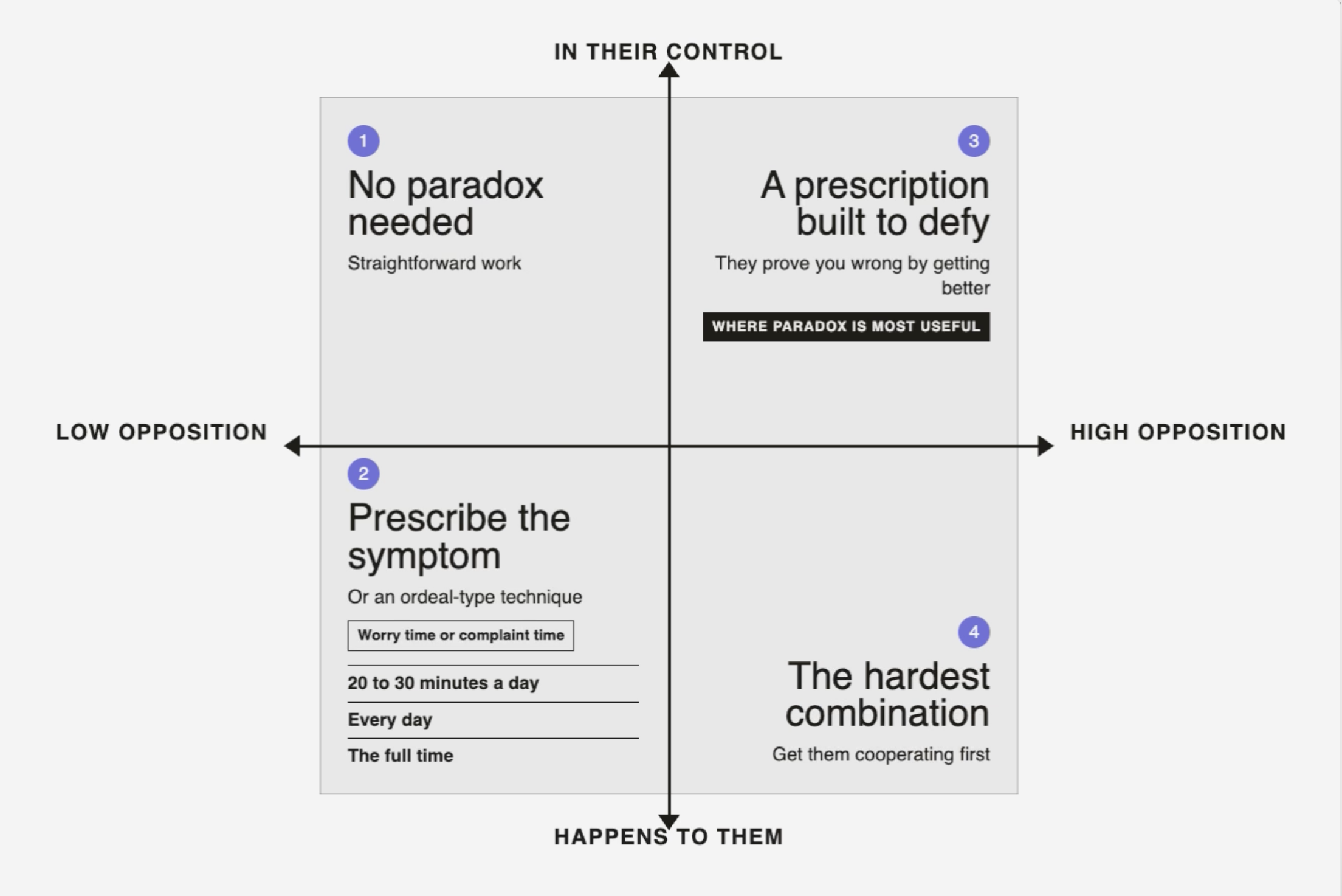
Put those together, and you get four boxes, and two of them suggest a paradoxical intervention is a good idea.
WHEN OPPOSITION IS USEFUL TO US
Part One: Behaviors
Most teenage clients are trapped in an ambivalent state around the symptom or behavior; part of him wants to keep it, and part of him wants rid of it.
When you push too hard on a client to give up a symptom or behavior, and they have some resistance or oppositional streak, you create a power struggle, and teenagers will dig their heels in and refuse to give it up.
The idea behind paradoxical interventions is that the therapist sidesteps the power struggle or flips it upside down, and essentially suggests the client keep the symptoms, own them even more, or practice them harder.
This same teen, who again has a bit of an oppositional streak, doesn’t like being told they have to keep the symptom and now wants to give it up.
Part Two: Identity
The second way to think about paradoxical interventions involves understanding how people see themselves, and more precisely, that most teenagers want to see themselves as independent, mature, smart, or self-sufficient.
We can use our understanding of our teenage client’s identity or values to our advantage to make changes, especially if they have this oppositional component.
We can label a behavior we want the teen to give up as clashing with how they see themselves.
- You likely see yourself as empathic and a good listener, so if I were to tell you that when you look at Instagram while I’m talking to you, it doesn’t make me feel like you understand me, you’re likely to feel mortified and put the phone down.
- That would have the desired effect because your behavior is clashing with how you see yourself.
So a defiance-based paradoxical intervention works by describing the client's behavior in a way that clashes with how he sees himself. They can only get rid of that discomfort by proving you wrong and giving up the symptoms.
Imagine a 15-year-old girl who has explosive tantrums when she doesn’t get her own way; we might say something like:
- For someone who is usually so eloquent and sophisticated, these tantrums you throw are quite immature; maybe I’ve made a mistake in thinking you were a young adult.
This is where a lot of well-meant paradoxes go sideways. Many of us assume that any "keep doing it" instruction will make an oppositional teen stop, and I've certainly assumed that. In practice, a family can take the line completely seriously and still not change, because nothing in it made anyone uncomfortable.
Playing it out a little further, if this teen keeps having tantrums when she doesn’t get her own way, I’m right, and she is immature. In which case, I would have her parents do obnoxious things like serving her dinosaur-shaped chicken nuggets or pushing her bedtime back to 8 p.m., like when she was seven.
If she has that oppositional streak, though, she will need to prove me wrong and show me that she’s not immature. The only way she can do that is to stop having tantrums when she doesn’t get her own way.
THE PROVE-ME-WRONG TEST
1. IT HAS TO BE BELIEVABLE
The intervention needs to be something the client and family could believe about themselves, that they know to be true. The teenage girl in the example above really does have to see herself as being more mature or eloquent; even though it may not be the full truth, it has to be something plausible and feel somewhat real:
- Use the family's own words rather than your clinical ones.
- Build it from what you saw in previous sessions or know about the client.
- Connect these observations in a way that makes sense to the family and to the behavior you want to stop.
Here's a real-world example from my days working in adolescent residential treatment.
Often teenagers were not happy about being sent to treatment, and having failed to convince me that they didn’t need to be staying in a luxury mansion in Malibu, they would call their parents. I’d listen to these angry calls home and hear teens beg, bribe, demand, plead, and threaten parents to come and get them, and after they’d calmed down, I’d drop the paradoxical bind.
I would tell them that teens who are ACTUALLY ready to leave tend to be nervous about it and they have done the work. The threatening calls to parents were actually proving to both their parents and me that this teen was in the right place and they needed to be here. The only way the teen could go home was to stop those calls and participate in the program.
2. IT HAS TO STING
We have to know the teenager or the family before we can use these interventions. In the video, I describe a teen who would be mortified to hear that his behaviors clearly told everyone he still wants his Mommy to look after him. The intervention wouldn’t work if this teen was ok with everyone thinking that.
There are two halves of the line I'd use with him:
- "I wonder if these spells are a way of looking after your mom." This might fit with how he sees himself as a good son, so that it can reinforce the symptom.
- "...and they're keeping you a lot younger than fifteen." This is the half that causes the bristle response, because no 15-year-old wants to be told he still needs his mom to take care of him.
When a behavior or symptom is framed as helping someone, check whether that's a flattering description or an uncomfortable one.
3. IT HAS TO FIT THIS PERSON
It’s hard for me to explain and teach paradoxical interventions because they are so unique to each case. Many defiance paradoxes come down to telling the client, "don't change yet."
To say this without knowing anything about the family and without understanding their situation seems absurd since the family is paying you to assist them in making changes. We always have to provide a reason for asking them to do or not do something. The key is to choose a reason that challenges the way this particular client wants to see himself, so that keeping things as they are becomes something he is unable to tolerate. There are three types of reasons:
- "The ‘therapy’ needs you to stay the same." This is for the client who hates being told what to do. If he doesn't change, he's obeying you, so he changes.
- "Changing is too hard for you." This is for the client who's proud of being a hard worker. Being told he can't manage it stings, so he changes to show he can.
- "Someone else needs you to stay the same." This is for the client who's already fighting with that someone. He doesn't want to be seen doing them a favor, so he changes.
Next time you’re stuck with a family or a teen, consider if a paradox is the right approach, and of course, if you’re uncertain, that’s what the consultation groups I run are perfect for.
Until the next time,
Oliver
PS - Get a mini-casebook on Paradoxical Intervention Types here:
Bogdan, J. L. (1982). Paradoxical communication as interpersonal influence. Family Process, 21(4), 443–452.




Responses