
Hi there!
If you missed the Circular Questioning Workshop I ran on The Family Systems Collective last week, I've got a recap video and in this newsletter I'll tell you how to get hold of the PDF handout that I made to go with it.

Circular Questioning
Circular questions enable us to shift from asking "What is wrong with this person?" to focusing on the interactions between people, and that’s the entire point of family systems therapy.
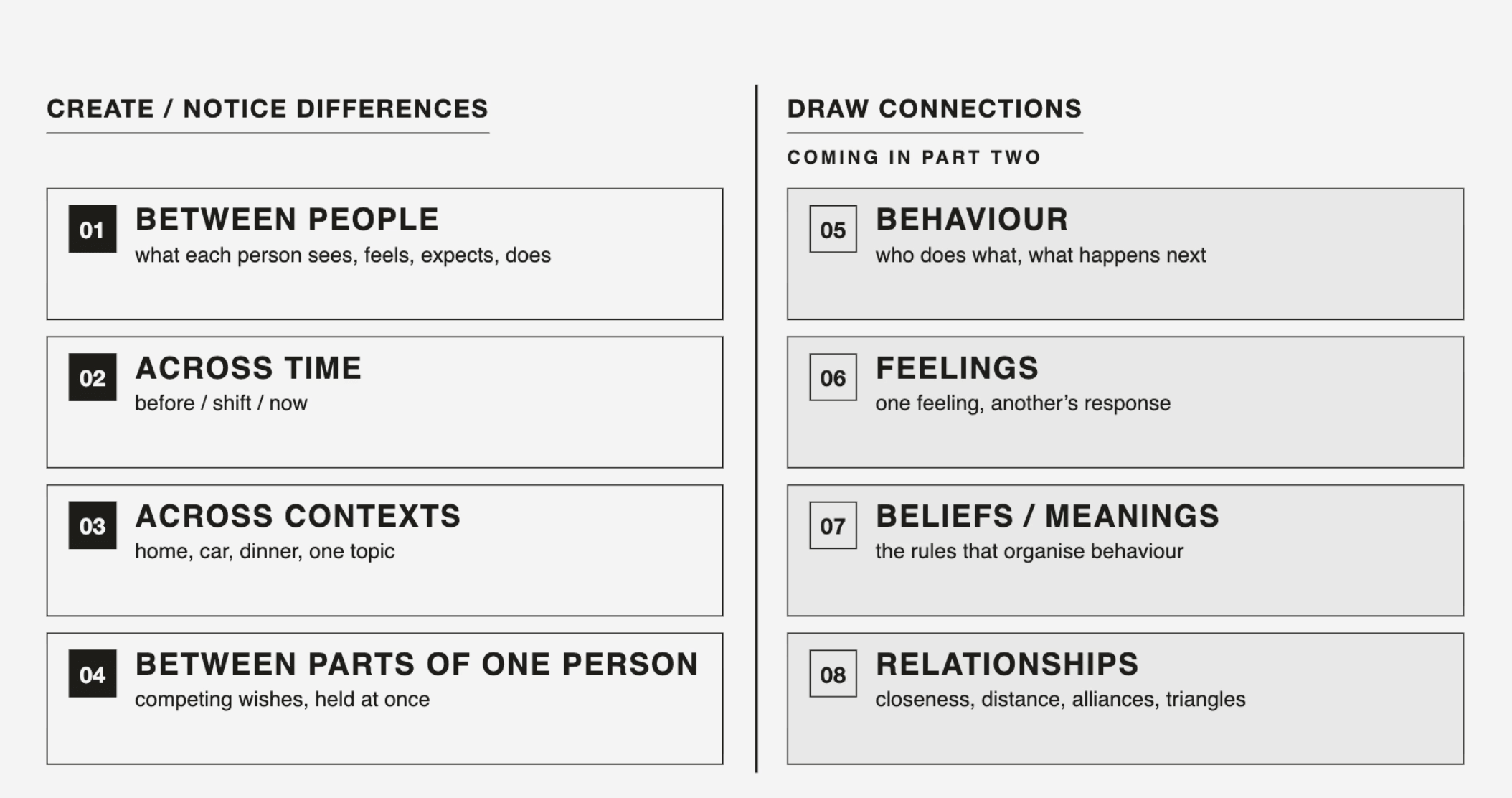
They help us spot differences, follow connections, and understand how a family's pattern is structured. Although the categories overlap, together they provide a helpful range of choices when we are deciding what to ask next.
Questions that notice differences
- Differences Between People
These questions look at how different family members experience the same situation differently.Example: “Who notices Maya going quiet first, and who is most likely to give her space?” - Differences Across Time
The questions aim to determine what has changed, when the change took place, and whether the pattern was always there.
Example: “Was Mum as worried about Maya before she started high school?” - Differences Across Context
The questions concern whether the pattern occurs everywhere or only in certain conditions.
Example: “Does Maya talk more easily at home, in the car, or when she is walking home from school?” - Differences Within a Person
The questions allow for conflicting desires, emotions, or "parts" of a person's experience.
Example: “What part of you wants to keep asking Maya about school, and what part knows she might need some space?”
Questions that make connections
- Connections between Behaviors
These questions follow what each person does next.
Example: “When Mum asks Maya about school, and Maya goes quiet, what does Dad usually do next?” - Connections between Behavior and Feelings
The questions examine the emotional reactions associated with each person's behavior.Example: “When Maya goes quiet, what do you imagine Mum begins to feel?” - Connections between Behavior and Meaning
The questions examine the beliefs that make each person's answer seem reasonable or necessary.Example: “Maya, what does Mum’s repeated questioning mean to you?” - Connections Between Relationships Or Alliances
They help us understand proximity and distance, coalitions, and the people who move toward or away from one another.Example: “When Mum and Maya get caught up in this conversation, who does Maya feel closest to — Mum or Dad?”
The goal isn't to put every family into eight categories, but to observe what kind of difference or connection might help you see the family's pattern more clearly.
|
How can you tell which type to use?
You really don’t need to run through all eight types like a checklist. Instead, listen for clues in the family’s description of the problem.
- If someone is being described with a fixed label, ask about behavior.
- If the family says something changed recently, ask about time.
- If the problem appears in more than one setting, compare contexts.
- If two people respond to the same event in very different ways, ask about meanings and beliefs.
The question type follows the clue in the scenario.
Scenario 1: “Leo Is Difficult”
Leo's parents say that he is difficult; each evening the homework turns into a quarrel since he ignores them, becomes rude, storms up the stairs and then slams the door.
The parents present the problem as though it exists within Leo; of course, that's how they see it, but it still doesn't tell us what happens among the family members.
The first thing I should do is enquire into the behavioral sequence, finding out what happens first, what happens next, and how each person reacts.
What do you usually do next when Leo doesn't reply to your question about the homework the first time?
I would continue mapping the sequence:
The parent tells him, but Leo doesn't reply. The parent then speaks up more loudly and Leo becomes rude. A person then goes upstairs with him. Dad joins in. The argument grows worse.
What we get here is much juicier than the term 'difficult', and instead we get a pattern that may be maintained by all of the responses, indicating several points where intervention could take place.
Scenario 2: “We’ve Been Fighting About Money Recently”
Priya and Sam state that they have been having constant arguments concerning money, and the word 'recently' gives it away.
It indicates that something has changed; although money might be the subject of the arguments, it doesn't explain why the pattern has become more intense now.
I want to ask questions that examine differences over time; specifically, I need to find out what their relationship was like before the arguments became so common and what was happening when things changed.
“Before these arguments became so frequent, when money was tight, what did you normally do?”
I should also ask about any changes that took place at that time; maybe someone lost a job, moved house, became a parent, suffered an illness, or took on new responsibilities.
What we're aiming at is not concluding that one event caused the conflict, but rather grasping how a change in their situations might have affected their roles, intimacy, or boundaries.
Scenario 3: “Adam Is Explosive Everywhere”
Adam's father says that he is explosive and disrespectful, and it is also mentioned that Adam has had similar difficulties with his soccer coach.
What stands out is that this behavior occurs in two different situations, which is why I'm interested in what these situations have in common.
In both cases, an adult man is correcting Adam, so instead of assuming Adam is explosive with everyone, I should ask about the differences by context.
"What is the same when your father corrects you at home, and your soccer coach corrects you?"
I would look for the conditions that make the behavior more likely, such as when Adam feels embarrassed, when he is corrected in front of other people, or when he perceives the adult's tone as disrespectful.
The question shifts our attention away from "How do we stop Adam from being explosive?" and toward "What is occurring in these situations that makes this response more likely?" So it offers us a more accurate starting point.
There's a PDF of all of this that goes into much more detail inside the 'Workshop' Classroom on The Family Systems Collective.
It's totally free to join and it's where you'll find more resources and upcoming workshops
Join The Family Systems Collective
Until next time,
Oliver & My People Patterns



Responses