
It was the best session you'd had with this family in weeks.
Dad finally held the line, Mom didn't rescue, and the fourteen-year-old actually did his homework without a fuss, so naturally you drove home blasting that Beyonce track you always play when you win.
Of course, the following week they sat down, and Mom opened with, "Well, it's been a terrible week."
Aside from the Beyonce part, has that happened to you?.
Yeah, me too.
In this episode, let's take a look at what’s going on when a family tells you:
- "It worked for two days, then fell apart."
- "He's back to his old tricks."
- "We tried what you suggested, and it didn't work."
And why it’s natural for therapists to think
- “This family is resistant!”
- 'The homework I set was too much.'
- “I moved too fast.”
- “I’m not cut out for family therapy”
House Keeping!
- If you're stuck with a family and need some ideas from a systemic perspective, join The Family Systems Consultation Group on Skool
- Do me a favor and leave a comment on the podcast if you listen, I'd appreciate the support.
- Listen to us on Spotify or Apple and this week's podcast is not related to the newsletter.... I'm trying something different and am not sure if that's helpful or annoying.
Let's go back to the fundamentals of family systems. A family has a life of its own, and maintains itselfthroughy a series of rules and behaviors. When the family’s eldest sibling moves out and goes to college, the family keeps going as it always has. The change didn’t affect them because they were flexible enough to resist it without collapsing.
In dysfunctional families, that flexibility has a very narrow range, and once you pass a certain threshold, the family will revert back to the way things were. I've had quite a few families call me recently, because the older kids are asking to move back home after a year or so in college. My first thought is that this is precisely that elastic effect.
When the system is pushed too far, when the changes are too big, how exactly does the family pull itself back to the shape it’s most familiar with?
The answer is the same: it's a set of rules or behaviors. In a session, you might hear clients say they feel they're not living up to the family's expectations or obligations. One of my clients spoke about this last week: the guilt trips and subtle put-downs their mother uses to get them to come home.
This self-correcting instinct is perfectly normal and indeed protective. It is also the very thing we have to battle whenever we need to make a change.
All of that is to say that it's often useful to read a family's behavior as being homeostatic rather than resistant; it's a useful reframing which is also a reminder that if you simply remove the symptom without re-structuring the system, you're going to leave a vacuum for a new symptom to emerge in, or for the family to revert back to where they were.
The Homeostatic Loop
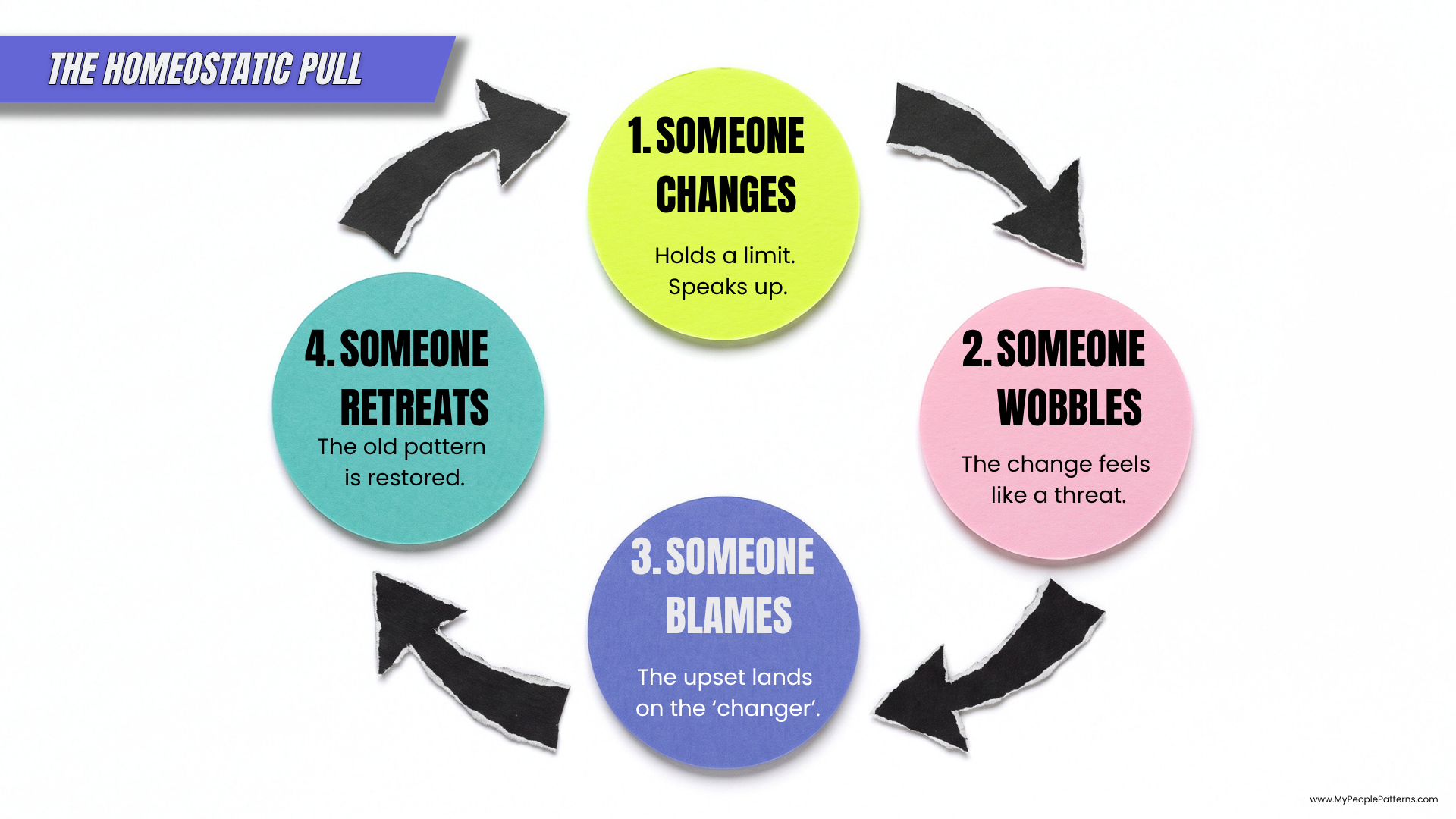
Every family has a thermostat in terms of how close they all stay, what happens when they’re annoyed, and who is in charge of what. If one person does something different or moves the dial, then the rest of the family (unconsciously) work to bring it back to the original setting.
The move back to the factory setting is the family protecting itself, treating any deviation by one member as a threat to the whole.
1.
The easiest place to catch this loop is step three, because you can hear it. Listen for “you make me.” You make me so worried. You’re making me crazy. You made me feel like I don’t matter.
When those words land on the person who just did something different, the family is in the third circle, and the fourth one, backing down, usually follows close behind. Your job in that moment is small but important: let the upset be real, and don’t let the person who changed be the one who has to fix it.
2
It also helps to know that the wobble's size tends to match the change's size. The more tightly a family is bound together, and the bigger the change someone makes, the louder the reaction is likely to be.
So when a family comes back after a good session and says it’s been a terrible week, it’s worth remembering this idea before you jump to blaming anyone. Often, the complaint that things aren't working is a sign that something has actually shifted, and the system noticed.
3
The most useful thing I’ve learned is to say it out loud before the family leaves. At the end of a session where someone has done something different, I’ll often say something like, “Something shifted in here today. Families tend to test a change like this, so don’t be surprised if this week feels harder before it feels easier.”
Then, to the person who changed: “Who’s most likely to want you to go back to the old way, and what will you do when that happens?” When the pull back arrives, the family has already been told to expect it, so it reads as part of the process rather than proof that they got it wrong.
The Rules Of Homeostasis
- Homeostasis is doing a job, and it's often the very symptom.
In the consultation group I had this week, the parents were quite clear with the therapist I was speaking to as to what they wanted to achieve. They wanted to fix the problem they were having with their child, either his grades or his behavior (you can pick).
It's so easy to go down the academic route, but these symptoms had only started to appear following the death of a family member. I can't help but think that the child's behavior may well be the family's way of going back to a 'normal' state after the loss of a loved one.
The symptom isn't just the problem they're in need of help with; it's also the family's current best way of coping with a problem they simply can't otherwise deal with.
2. Resistance To Change Is A Reason To Join
All families are systems and all systems have a degree of homeostasis (the tendency to stay the same). Joining is so important as your first technique in structural family therapy because you need to have enough rapport to be able to exert a significant amount of influence against the family's tendency to stay the same.
If you're having an existential crisis about Artificial Intelligence taking over our jobs, then there might be some comfort in this. Advice-giving in itself (whether by a human or an AI) won't be enough to change entrenched patterns.
3. An Unhappy Equilibrium Is Only A Problem When It Blocks Growth
It’s sometimes hard to imagine that a family that appears unhappy, or that explains disturbing behaviors in the child, is simply living in a way that feels ‘normal’. It doesn’t look normal, and it may not feel normal to them, yet the structure the problem creates is familiar in some way to the family.
The issue we should be looking at is whether the problem and its homeostatic effect are in fact preventing the family from growing and evolving. I'm thinking of those same young adults I referred to earlier who are coming home from college.
My real worry is that the family dynamic isn't conducive to them launching, rather than the reason why they are moving back in.
That's it for me this week, come find me in the Family Systems Collective or in a consultation group,
Until next time,
Oliver


Responses