In my first family session, I let the most talkative member steer the session for 40 minutes, while the rest of the family observed.
Nobody taught me that opening a family session follows a sequence, with specific signs and a clear moment to shift from rapport-building to therapy, so I didn’t give much thought to my first question or see it as a structural decision that shapes the session.
So of course, I was bulldozed by a talkative parent and rendered utterly ineffective.
<sighs>
This week, I’m sharing a few of the things I wish I’d known before that session, so you don't have to live through it!
TLDR:
This post covers three things: how to open a family session with intention, how to hold the room once the family starts talking, and what you're really listening for underneath everything they say. There's a free PDF at the bottom with the SHIFT Protocol and the Four Don'ts—both session-ready and ready to use immediately. Download it now, try its strategies in your next session, and let me know how it changes your approach.
In every first family session, a key moment comes when you move from casual chat to real work. Jay Haley of Strategic Family Systems even devoted a chapter to it.
Your first question will be about the problem, but your wording and who you address first shape the session.
This moment marks the shift from conversation to therapy. If you’re unclear, the family may not know if they’re in therapy or just chatting.
The way you ask the first question is more important than most training programs suggest. In practice, three common versions lead to very different conversations.
"What's the problem?"
It’s simple and clear, but invites a diagnosis. The appointed spokesperson usually answers, pointing at the identified patient.
"What changes do you want?"
It’s a good one that shifts the family’s focus. Instead of describing what’s wrong, they think about what they want to be different. This moves the conversation toward action, making it harder to say, "Jimmy is the problem."
"How can I help?”
This is the most personal option. It makes the conversation collaborative right from the start. This question often leads to a pause, which usually means something important is about to happen.
None of these questions is always right. I usually say some version of:
“What’s the problem in the family that I can help with?”
Experiment with your own version. Here’s why I like mine:
- ‘What’s the problem in the family?’ makes it distinct from the question of who the problem is.
- It also sets the tone for this being family therapy, not individual therapy, with an audience.
- " ....That can I help with?" makes it clear that I’m not going to be able to help with making money or buying a new house- I’m here in my role as a family therapist.
The Shift Protocol
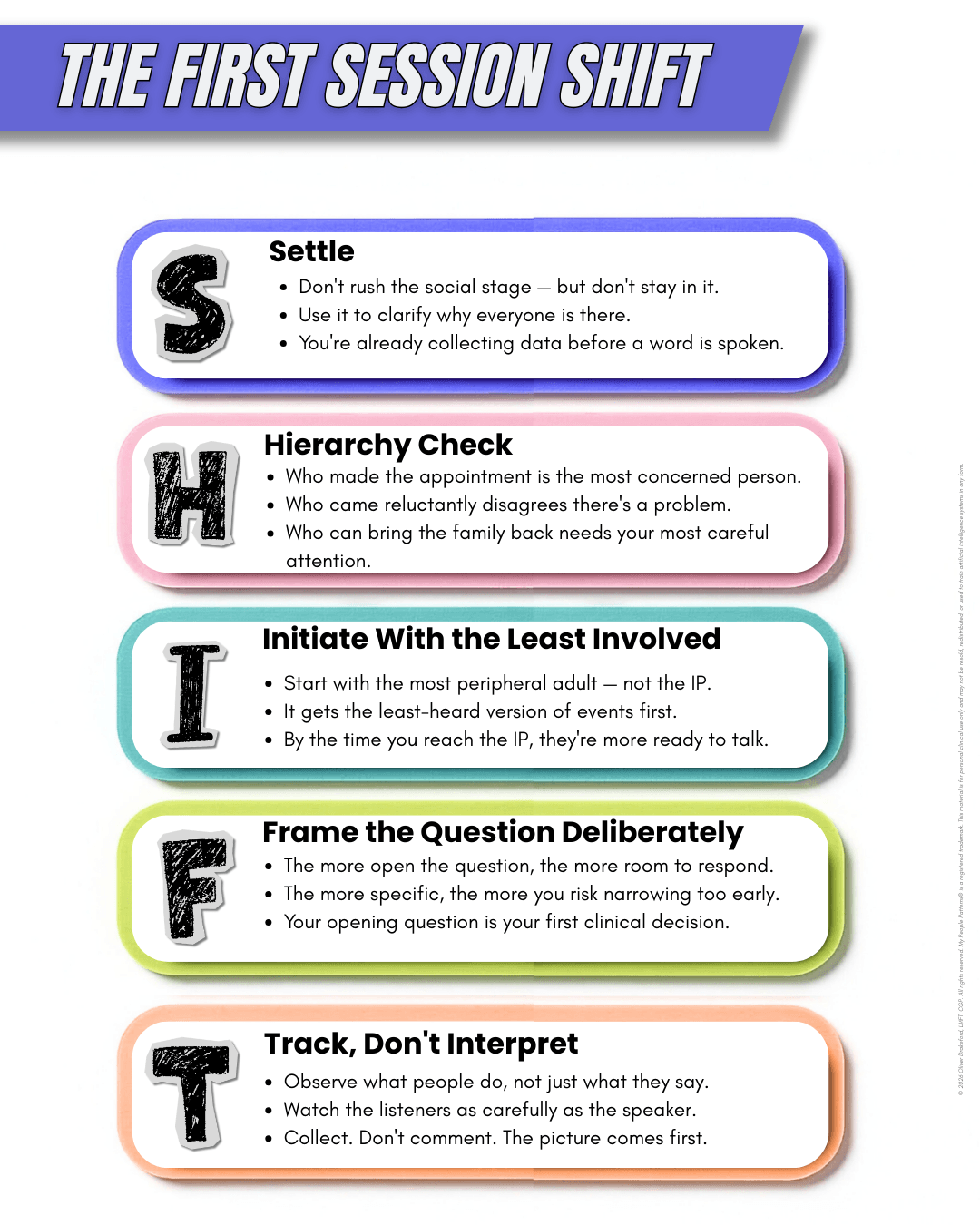
Seeing the session start as a plan, not casual talk, helps. The SHIFT Protocol offers five steps—simple to remember, specific enough to guide you.

S — Settle
Finish the greeting before moving on. Notice seating and interactions—even small talk is informative. When everyone is present, proceed.
H — Hierarchy Check
Before you ask the first question, look around the room. Who seems most on edge, either physically or emotionally? Who is anxious to speak? Who looks like they’d rather be somewhere else? You’re not diagnosing yet. You’re just noticing each person’s position, which will guide your next step.
I — Initiate With the Least Involved
This step may feel unnatural, but start with the most sidelined person, often the less involved parent. Doing so includes everyone and provides a fresh perspective.
F — Frame the Question Deliberately
Decide on your opening question before the session starts. Use the three options from earlier as a guide. Each question leads to a different conversation. The question you choose is your first structural intervention, so treat it that way.
T — Track, Don't Interpret
Once the family begins talking, your role shifts. You’re there to gather information, not to comment. Don’t offer reframes, reflections, or early guesses. Watch, listen, and take note of what’s said and unsaid, who looks at whom, and who changes the subject. Interpretation comes later. For now, you’re building a picture.
Managing The Room
So the family is talking. Here's where it gets harder.
Starting the session well helps get the discussion flowing. Managing the room is what keeps things productive, and it’s a skill that individual therapy training rarely covers. In individual work, you only track one person and one relationship. In family therapy, you deal with interruptions, changing alliances, someone who talks too much, and someone who won’t talk at all. New therapists often want to sit back at this point. Resist. If the family takes over, the session repeats home dynamics, which you want to change. If someone takes over, the session will go just like it does at home, which is exactly what you want to change.
Your job is to maintain the conversation structure. You don’t control what people say, but you do guide who speaks, for how long, and in what order. This isn’t a neutral task; it’s a clinical responsibility.
A few things are worth watching out for:
If one family member, the family spokesperson, starts to dominate the conversation, I’d resist letting them continue, even if what they’re saying is clear and the information seems useful. Allowing one person to take over means you’re siding with their view, even if you don’t mean to. The others notice, even if they don’t say anything. The person who hasn’t spoken yet isn’t just quiet—they’re waiting to see if it’s safe to share their side.
Interruptions are important clues. When someone cuts off another family member, it shows you how the family works. You don’t need to interpret it yet. Just briefly acknowledge the interruption, pause, and then return to the person who was speaking. This small action reveals more about your session’s structure than a long explanation would.
Pay as much attention to the listeners as to the speakers. While one person talks, the others show you a lot—who gets tense, who nods automatically, who looks at you for your reaction, and who seems bored as if they’ve heard it all before. The nonverbal reactions of those not talking often tell you more than the words of those who are.
If the room feels very emotional, the family is likely in a real crisis. If everyone seems detached or flat, the family’s patterns may be deeply set. Neither is better nor worse; each just needs a different approach from you.