
As much as I love collecting data and family therapy assessments, the truth is, you don’t need a complete picture of the family to start working systemically. You do, however, need to know a few patterns that keep the problem going, and you need patterns you can actually see happen in session, because those are the ones you can change.
The goal of this newsletter is to give you the simplest description of common patterns you can identify that will lead to the fastest change in the family you’re seeing.
If therapy targets these patterns, it can move quickly, and you can see change and improvement fairly quickly. (I’ve written before about my best and worst case as a family therapist -where I fixed the problem in three sessions and never saw the family again!) . If the patterns are not changing, that is your signal to change strategy, rather than keep going with a plan that isn’t working.
Housekeeping!
- There's a PDF you can download that has these six patterns - click here
- Join The Family Systems Collective to get your full FREE video course on Family Assessment
- There's a podcast this topic - you can find it on Spotify and Apple and Amazon

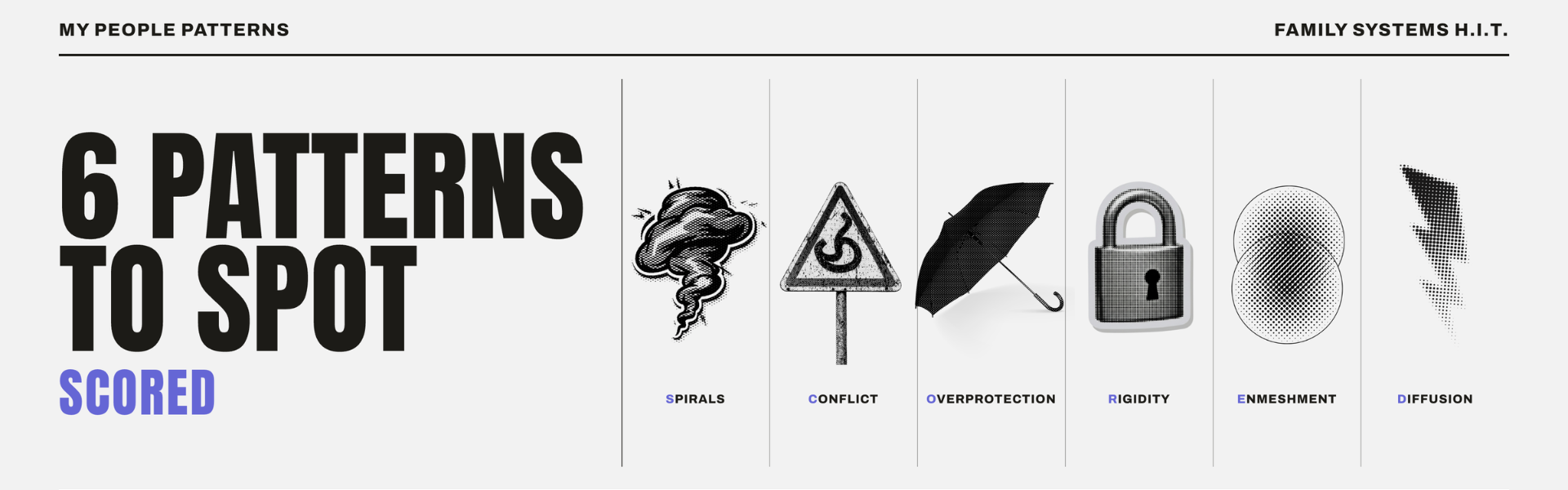
These are the six patterns I think any family therapist can start looking for.

1. Conflict avoidance
Some families go out of their way to avoid disagreeing openly. You can see this when you ask the parents to talk to each other about a difficult issue. Instead of talking to each other, they answer you, or they turn to the children. Each time the conversation nears a real disagreement, they move back to safer ground.
A couple that cannot deal with their differences often cannot agree on rules or consequences in their family - this is what one of the therapists in my consultation group is dealing with. An anonymized version of what’s going on is this kid won’t go to school, plays video games, and won’t do homework. The parents seem to have different ideas about the house rules, and when this therapist asks them to settle their differences and decide between sessions, they derail and never come back with a list of rules.

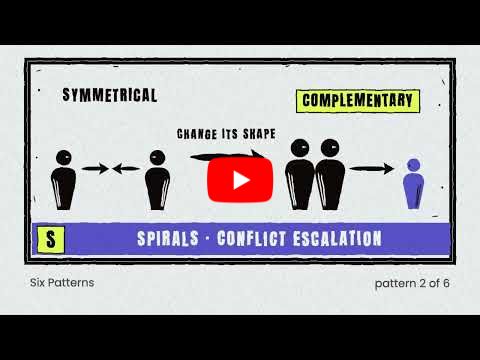
2. Escalation (complementary and symmetrical)
Some pairs in a family get locked into an exchange that gets worse each round until something breaks, there’s two different types you can spot:
In the complementary escalation, the two people do opposite things that fit together. A wife who is angry and a husband who complains of stomachaches. As it escalates, she gets angrier, and he gets sicker, until he has a bleeding ulcer.
In the symmetrical escalation, both people do the same thing. A heated argument where neither person can back down. As it escalates, both sides may get angrier and increasingly louder.
The question to ask yourself in the room is simple: are these two people doing opposite things, or the same thing, and is it getting bigger?

3. Enmeshment
Enmeshment is extreme closeness and intensity in a family; I’ve written about this before, and I love to point out the difference between enmeshment, closeness, and intrusiveness. Boundaries between people blur, and family members lose track of the difference between themselves and each other - they don’t know where one person ends and the other begins. People speak for each other, react for each other, and assume they know what the other person feels.
Salvador Minuchin had a famous example with a father, a mother, and their 12-year-old diabetic daughter. Minuchin squeezed the girl’s arm and asked the father, “Can you feel that?” The father said, “You know, it’s odd; I can feel that!”
When Minuchin asked the mother, she said, “I can’t feel that, but I have poor circulation.” Neither parent questioned whether they should be able to feel their daughter’s arm being squeezed!

4. Rigidity
A rigid family keeps doing things the way it always has, even when the situation clearly calls for change. This is especially hard on families with teenagers, because a teenager’s growing need for independence pressures the family’s usual rules. The rules and consequences that worked for a four-year-old don’t work with a fourteen-year-old. A rigid family resists that pressure of change, instead of adjusting.
Rigid families often send the teen fixed messages.
- One is “You are valued for what you do, not for being you.”
- The other is “No matter how hard you try, the family does not want you.”
In the most severe cases, the teen feels the only way to be heard is a dramatic escalation of behaviors, including suicide, depression, or acting out and rule-breaking.
In the room, listen to how the parents describe the teenager, and what they seem to value in them.

5. Overprotectiveness
In an overprotective family, members show so much concern for each other that the young person never gets the chance to become independent or competent. They take care of every need, and they discourage every attempt to stretch. Last week I talked about parental accommodation and family accommodation, and you could think of these two concepts as overlapping a lot.
As I write this, I am not certain I can think of any recent examples of parents being overly protective in the traditional sense of not letting their child go to hang out at the park on a weekend. I think these days, parents are a bit more clued up about this so you might see it in subtler ways. A family I consult with an associate on baffles us, as they bought their child an outrageously expensive electric scooter because they don’t want their child to walk.
The takeaway for your work is that overprotection can come from the wider system, not only the parents. It is worth asking what the young person has wanted to try, and who stopped them.

6. Conflict diffusion
Conflict diffusion is what conflict avoidance looks like in session. When tension starts to build between two people, a third person steps in and lowers it, and the original conflict never gets dealt with. Watch for the person who steps in being the child or teen with the symptom - this is a form of triangle, obviously, as Murray Bowen talked about. He says that a two-person relationship is inherently unstable, so it’s natural for us to triangle in a third person, even if it’s in the form of venting to your partner about your mother.
You can see this often when working with families with younger children, especially when there’s more than one child in the room. A parent and one child might get into a heated debate only to get interrupted by another child complaining about something related to the topic OR, utterly unrelated. If this happens once, it could be one kid wanting attention, but if it keeps happening in different ways, it’s a pattern. You might notice then that almost every time a conflict was about to come up, someone interrupted, and the conflict was forgotten.
The test is repetition—track who steps in, and whether the topic gets dropped every time.
Families with lots of enmeshment, rigidity, or overprotectiveness often cannot handle conflict directly, so diffusion is common in those families.
How to use the list: enactment
You find and spot these patterns by watching the family interact, not always by asking questions, and the main technique we would use is enactment.
The quick quide to enactments is as follows,
- Watch how the family interacts on its own and decide which problem area to focus on.
- Set up a conversation in the session so the problem pattern plays out, and push a little to raise the intensity if needed.
- Challenge their interaction until a better pattern emerges.
For this to work, we have to step out of the center of the conversation and let family members talk to each other. That can be risky if you think your job is to keep the peace and not let people fight in therapy - let it happen for a few minutes and then reel it in, you're missing out on valuable data if you control things too much.
A practical way to start: pick the pattern you suspect, ask two family members to talk to each other about a real issue, and watch.
- Does someone interrupt?
- Does it escalate?
- Do they turn to you?
|