With nearly every family I work with, I eventually end up asking myself “What are the rules in this family?”
I’m obviously not referring to new rules like “no phones at dinner.” Instead, I focus on the unspoken rules—those every family member recognizes, but no one articulates, and it's often these rules that are playing some part in the problem the family is looking for help with.
TLDR
Every family runs on unspoken rules — but what most clinicians miss is this: every rule quietly generates its own opposite, and that counter-pressure is often exactly where the symptom lives. This week, I'm breaking down the five-part anatomy of a family rule and sharing a session-ready acronym for tracking them in real time, plus the questions to ask in session about rules.
This Week's H.I.T Home & Take Home Free PDF For Subscribers:
- The Family Rules Cheat Sheet
- The Five Ways To Spot Rules
- The Rule Finder Questions
Also:
- SALE: 20% Off Family Systems Step By Step or Advanced Family Mapping with the coupon code APRIL26
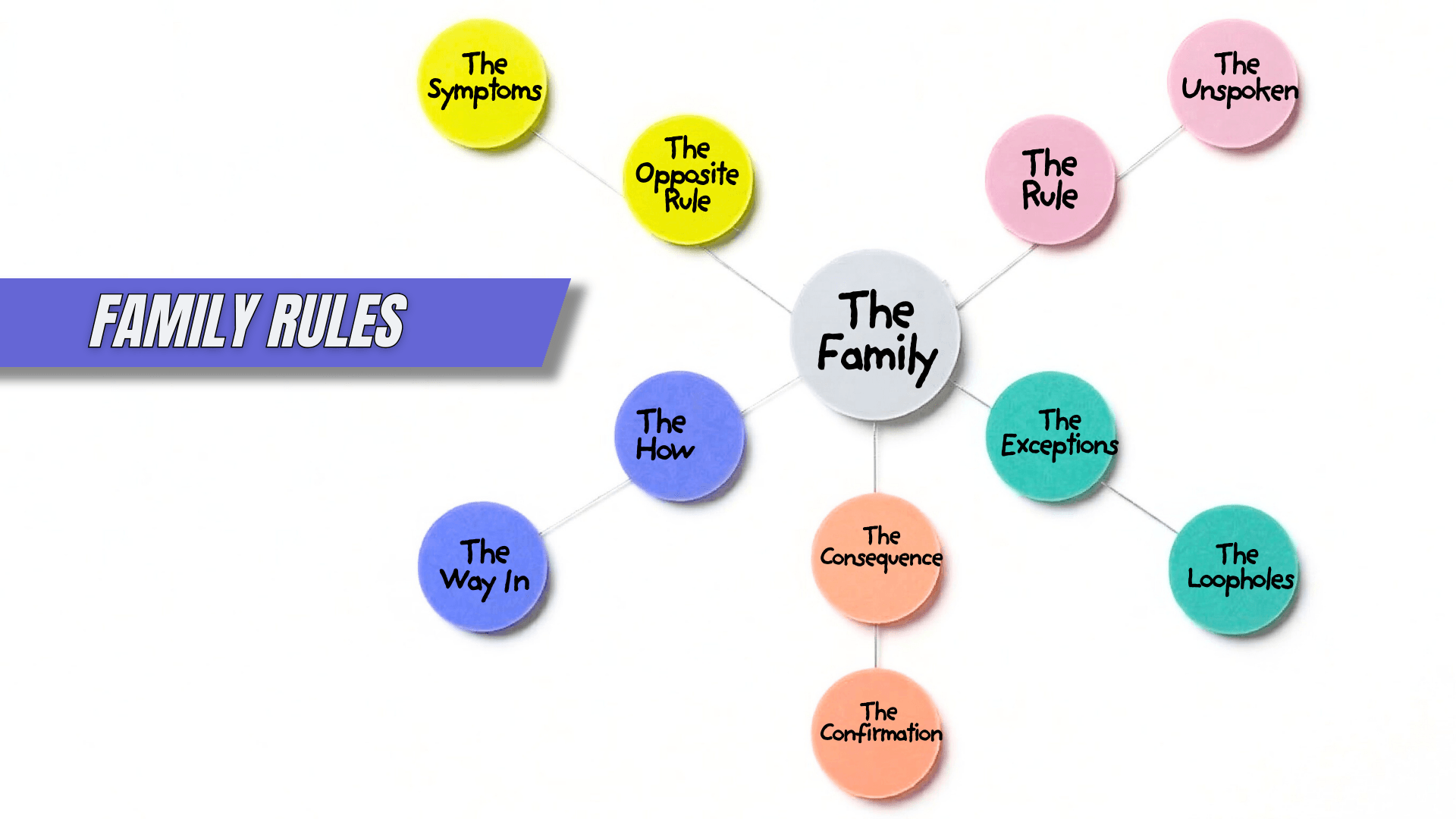
This week’s post is inspired by Dr. Frederick Ford, a family therapist who believed rules were so important that he called them “the invisible family.” Since the 1980s, research on this topic has grown. I’ve found this theory especially useful in my own work, and I want to share some practical ways to use it.
1. The Rule
This is the core, unspoken instruction. It’s usually the first thing you notice, but only if you know what to look for.
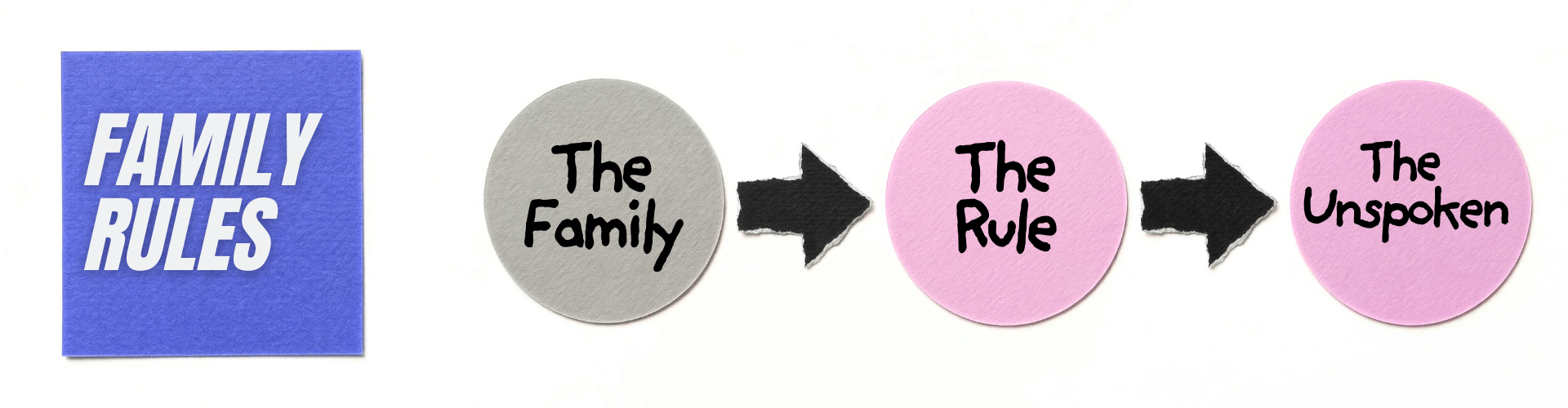
A family rule is an unstated message or instruction that determines how a family acts. For example, in my family, one early rule was ‘we don't talk about money.’ Even now, I don’t know what my parents earned before they retired, and bringing up money at dinner still makes them uneasy.
No one ever said this rule out loud or wrote it down. That’s how family rules work—everyone knows them, but no one can say exactly how or when they learned them.
The Implicit and The Unspoken
The thing that makes family rules so clinically significant and so stubborn to shift is directly related to their implicit nature, which means they carry the properties of a secret. And secrets give power over others, induce guilt, and control or regulate intimacy.
More importantly for us therapists, the moment you name a rule out loud in a session, it starts to lose this power, and it is often the most disruptive and useful thing a therapist can do. If you can read the rule out loud, you are not just reading the present operating engine of the family; you are reading where this family has been, and where they are heading without intervention.
2. The Opposite
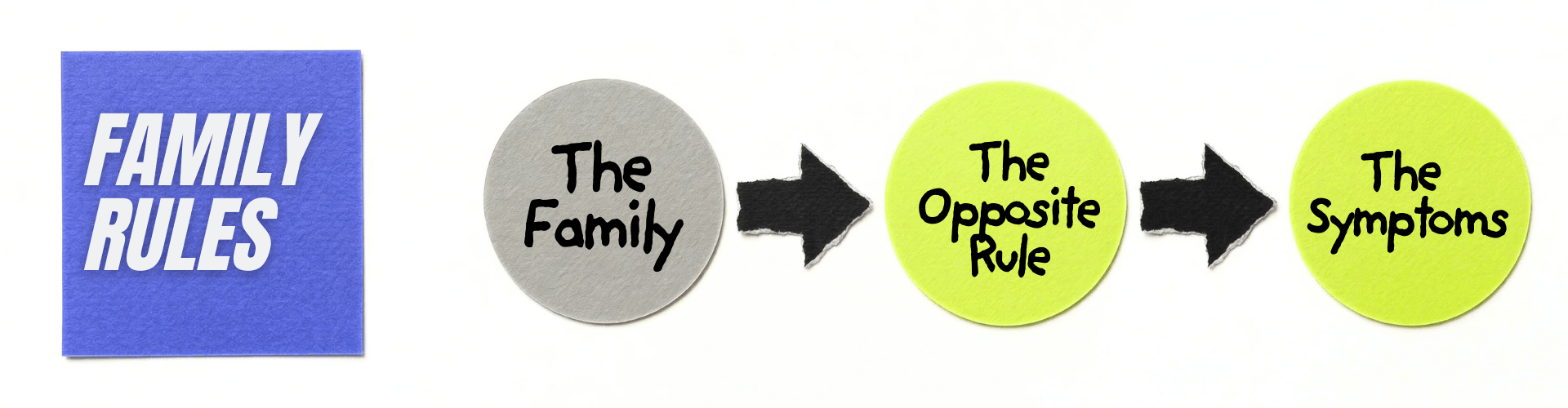
Every rule creates a force, and every force has an equal and opposite effect.
In order to understand this aspect of family rules, it’s vital you do not think of a pink elephant. Whatever you do, no pink elephants should enter your mind for the next thirty seconds
It’s impossible, right? This is ‘ironic thought process’ in action. The mental effort to suppress a thought requires you to constantly monitor for that thought, which means you're always, on some level, generating it. The suppression and the thought are inseparable. You can't have one without the other.
The counter-rule works the same way. "Don't fight" requires the family to constantly monitor for fighting, which keeps fighting psychologically present at all times. The rule and its opposite are bound together. You can't install one without quietly activating the other.
The Symptoms.
The more a family’s rules are enforced, the stronger the opposite effect is charged. For example, the harder you try not to think about a pink elephant, the more that image pops into your head. The family that insists loudest that "we don't have conflict" is often the one where conflict is most pressurized, most dangerous, and most likely to erupt through the identified patient.
The symptom is frequently where the counter-rule finally breaks through. The child who "acts out for no reason" in the "perfectly happy family." The teenager who lies compulsively in the household where honesty is treated as sacred. They're not defying the rule exactly — they're carrying the counter-pressure the rule itself created.
3. The Exceptions
This is the fine print, which, if too narrow, makes the rule a cage. If too wide, it ceases to have a purpose.
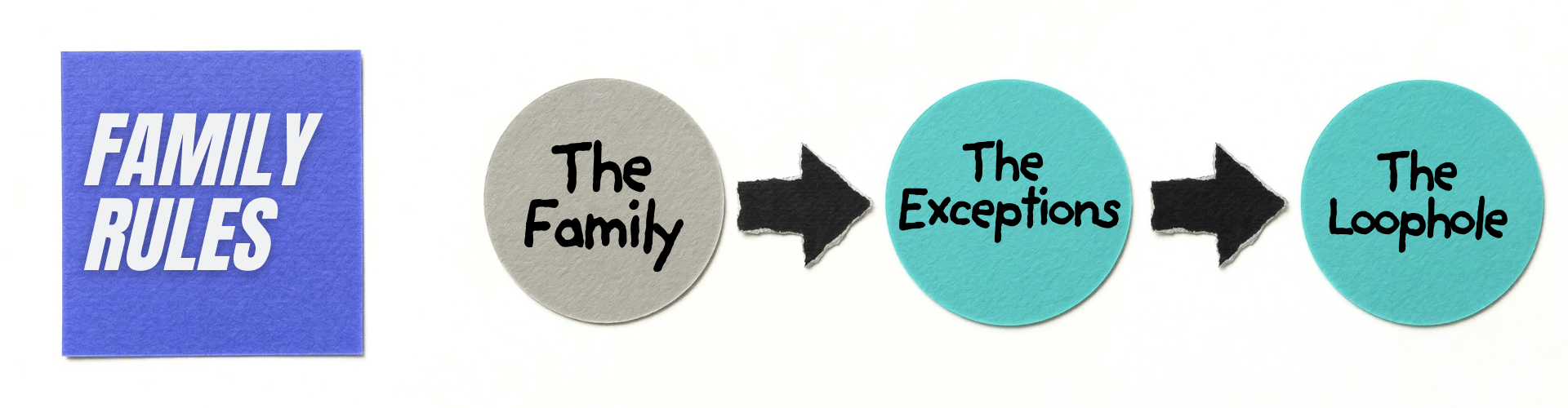
Every family rule needs a bit of flexibility; if my family’s rule were literally to never talk about money, I wouldn’t be able to discuss fees with clients or talk to my accountant. If that same rule were ‘we never talk about money on Tuesdays, there would be no point to it.
In a similar way, a family rule that says “we will always be nice" without any exceptions doesn't necessarily produce a nice person. It’s more likely to produce someone who gets walked over, or someone who explodes or implodes. The exception is what makes the rule liveable.
- "Be honest... but not at someone else's expense."
- "Be nice... but not if people are unkind to you."
The qualification is what stops any rule from eating itself alive.
The Loophole
In therapy sessions, we have to go beyond just asking ourselves, "What is the rule?" We also have to ask whether the exceptions to the rule are adequate. In families where exceptions are too constricting, they often split into two camps. One party maintains strict compliance with the rule, and the other is likely to exhibit spectacular rule-breaking behavior, with nothing in between. The identified patient is usually living at one of those two extremes.
Talking about exceptions to the rule is often less threatening to the family than challenging the rule itself, because so much of the family identity is wrapped up in it. However, identity and cohesiveness are not in the fine print, and we can ask questions in this realm without triggering any defensiveness.
- "Is there ever a time when it would be okay to break this rule?”
- “What makes that different?"
The answer tells you not just where the exceptions currently live — it tells you where they could be stretched, and how much room the family has to grow without feeling like they're losing themselves.