

Case conceptualization for family work is hard; it’s easy to blur modalities and start thinking about attachment styles, then consider the DSM-5 diagnosis, IEPs and learning difficulties too. If you want to take a systemic approach to case hypotheses, I’ve got a simple way to organize all your thoughts and observations.
TLDR: A family case formulation lives on one page in three columns. History on the left, beliefs in the middle, the behavioral loop on the right. You read it left to right, and you fill it in right to left. Once it's finished, it hands you three things: who belongs in the room, where the resistance will come from, and the one or two places where pushing will actually work.

Worksheet and video are available in the community
Housekeeping
- I've launched a free family systems community, and this issue arose directly from a member's question about case formulation. The video is available inside the community:
- The video that explains this is in the classroom.
- The circular questions I mention below are in the downloads classroom.
- I'm finishing up a worked-through case walkthrough using this exact framework in the case study classroom coming very soon, where you'll see the columns filled in for a real family.
What Makes This Systemic
Systemic therapy holds the idea that the symptom the family wants help with lives in the relationships between people, not inside any one of them. The person carrying it is the identified patient.
A structural family therapist isn't especially interested in why this person has this symptom. The question we ask ourselves is usually along the lines of this:
- “How is the family's way of interacting keeping the symptom alive?”
Families will hand you a linear explanation of what the problem is, and they'll hand it to you fast.
- He won't go to school because he's anxious.
- She won't do as she's told because she's oppositional.
Therapists aren’t immune to this way of thinking either, we totally do this to:
- The kid won't go to school because of an anxious attachment.
- They are struggling because of their ADHD.
None of that is wrong or incorrect; there's often a lot of truth in these things, but if you’re doing systemic therapy, let's stick with a systems way of thinking. That means we’re looking for the circular explanation alongside the linear one.
- A circular explanation makes a loop. The family organizes around the problem in a certain way; that organization reinforces the problem, and the problem keeps the family organized that way.
- A linear explanation usually just ends in blame or a label.
However, for this worksheet, we are interested in both, and you’ll see how linear helps explain the circular in a second.
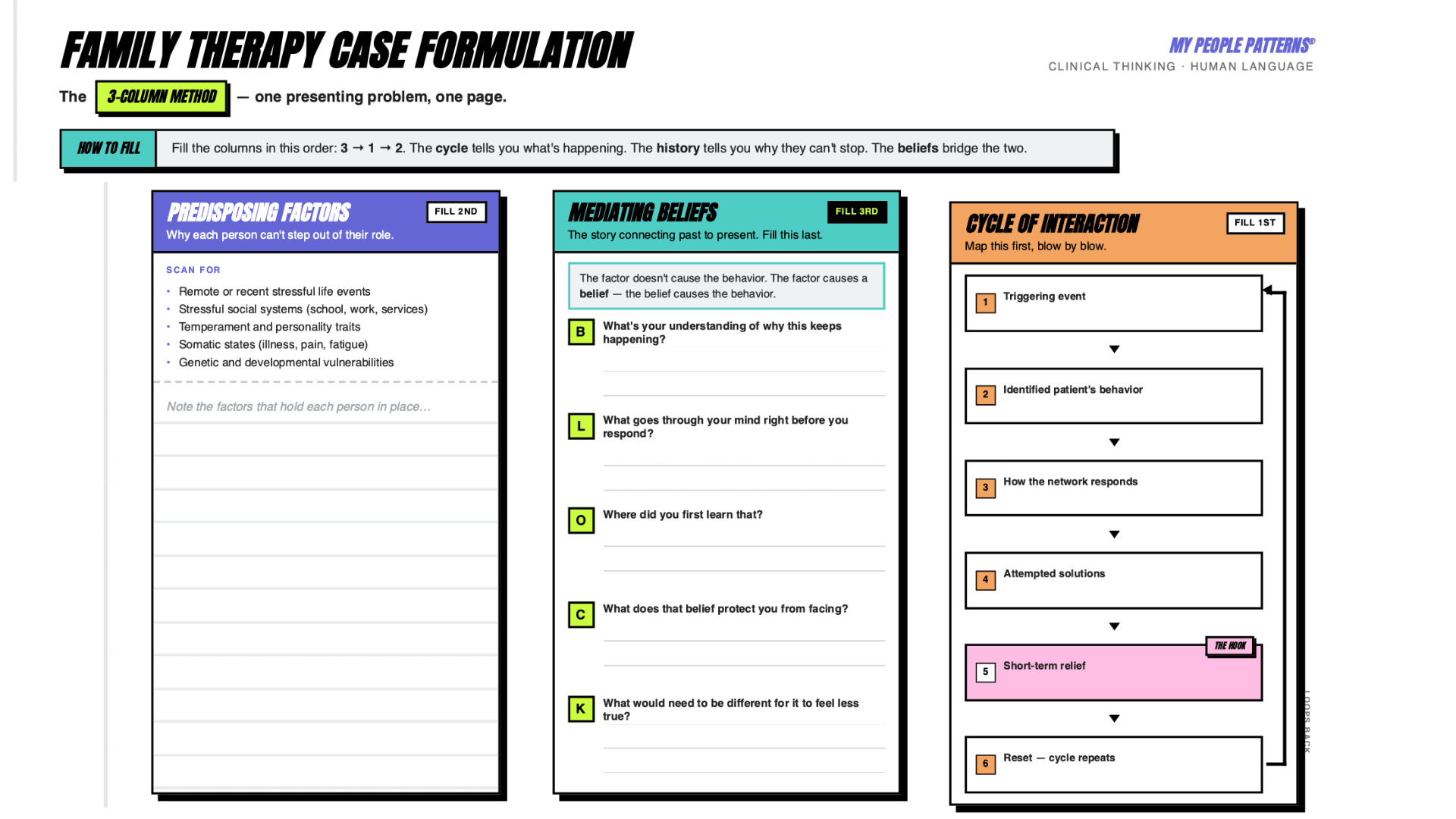
3.The Loop.
Everything in this column is something you can observe. That's what makes it different from the other two, which are built out of what people tell you about themselves, and which therefore arrive already edited. This column contains the behavioral sequences that exist around the problem.
- Jenny refuses to go to school.
- Mom takes her to work.
- Jenny plays video games all day.
- Dad finds out later in the day.
- Mom and Dad fight about it.
- Jenny refuses to go to school.
First, you have to define the problem, and it has to be a behavior, then map out at least six types of interactions that go around it:
- The trigger, meaning the event that kicks the episode off.
- How the identified patient gets treated while the symptom is showing.
- What everyone tries in order to deal with it are the attempted solutions.
- What those solutions produce.
- How the wider network responds to that outcome.
- And then the reset, which is how time gets spent until the trigger reloads.
Everyone plays a part, and the coordinated dance that leads up to the problem usually relieves some tension for a moment. That relief is exactly what makes the whole thing run again. The cycle is the engine of the symptom.
Use direct questions to trace the sequence, and circular ones to trace it around the room.
- What did you do next? (Direct)
- When Mum reprimanded her, what did Dad do? (Circular)
1. The History
This is the linear column that cntains historical data and more linear thinking. The information you enter in this column is not a set of factors that fully explain the problem from a systemic perspective.
Five categories to collect.
History. Recent stressful events like job changes, financial strain, and an older sibling leaving for college. You're building a timeline of what's been added to this family lately.
System. The parts of the system outside whoever lives under the roof. Grandparents, the school, the church, and a previous therapist.
Temperament. A child who's hard to soothe. A parent who grew up avoiding conflict. Introversion, extroversion, character.
Body. Chronic illness, disability, pain, fatigue.
Biology. Learning differences, neurodivergence, psychosis. You need to know about all of it. You're not labeling any of it as the cause.
The one I always forget is the system. Parents come in so focused on their kid that it won't occur to them to mention that the job is impossible or that they're in the car four hours a day.
Build this column with a brief developmental history for each member. Separately with the parents, separately with the kids, sometimes on the phone between sessions. Give each person their own row, and you'll see why in a moment.
2. The Belief
Two kinds of material live here. There are beliefs about self, others, and relationships, often handed down as family scripts.
- I'm not lovable.
- I'm a failure.
- Conflict is bad, and if we're fighting, then something has gone badly wrong.
Then there are the habitual ways people read events, which is where cognitive distortions, attribution biases, and defenses show up.
- Praise given to a sibling gets read as favoritism when it was just praise.
They all protect something, and they all restrain something. Which is what makes them so hard to shift, because these beliefs usually aren't irrational.
There's a five-question sequence I use to surface them in a few minutes.
- B is for belief. What's your understanding of why this is happening?
- L is for link. When your kid acts out, what goes through your mind just before you do what you normally do?
- O is for origin. Where did you first learn to do that?
- C is for cost. What does holding that belief protect you from having to face?
- K is for key. What would need to shift, even slightly, for it to feel less true?
This column is the most clinically useful one you'll write, because it explains why your interventions keep failing. You can't change a behavior without touching the belief sitting underneath it. It also gives you the raw material for positive connotation and paradox, and it tells you whether to work with this family directly or sideways.
Putting It Together
Now the fun part.
Pass one. Read one row, left to right.
Take one person. Their predisposing factors created a belief. That belief explains the move they make in the loop.
- THE HISTORY: A parent who grew up in a high-conflict house
- THE BELIEF: This parent believes that conflict means the family is falling apart,
- THE LOOP: They avoid setting a consequence for an oppositional teenager.
The three columns all make sense - they're absolutely trying to keep the family together. They're just doing it in a way that leaves the teenager without a limit, and we know why.
When you do that for every person in the cycle, each row becomes a short, compassionate account of why that person's part feels necessary to them. This is the pass that stops you from seeing anyone as difficult or unwilling, because you can trace every move back to something that makes sense.
Pass two. Zoom out and read the whole page.
The right column tells you what happens. The left and middle columns tell you why it happens and why it can't stop. So the behaviors on the right are held in place by the histories and beliefs on the left and in the middle.
The loop is frozen, and it's frozen by individual people's histories and convictions.
That’s a pretty complete formulation that gives you a live pattern of interaction, plus the reasons each person is finding it hard to stop.
The worksheet more or less writes the treatment plan.
- Who needs to be in the room? The right column determines your invitation list, not the referral form or who booked the appointment.
- Where is the resistance coming from? The left and middle columns. If the family believes she's always been difficult, they're going to resist any suggestion that her behavior is a response to something, and now you know that before you say it out loud rather than afterward. The beliefs tell you what not to do, and they tell you which convictions you'll eventually have to touch.
- Where to push. You can break the chain at any single point in it. If you can't get anywhere with the teenager and their anger toward Mum, then work with Mum and her difficulty setting a limit. The formulation shows you two or three places where pushing is likely to have an effect, and you get to pick the one that's most available to you.
So the finished page gives you an understanding and a plan in the same twenty minutes. You can see the loop, see what's holding it up, and see where it's weakest.
One question for me. Which column do you find hardest to fill in? I have a hunch it's the middle one, and I'd like to know if I'm wrong. Hit reply.
Until the next time,
Oliver





Responses