
A first family session hands you an enormous amount of information at once, and in family systems therapy, there’s information that goes beyond what each member of the family says. Even if you manage to collect all of this information, most of us were never taught how to sort it out or make use of it.
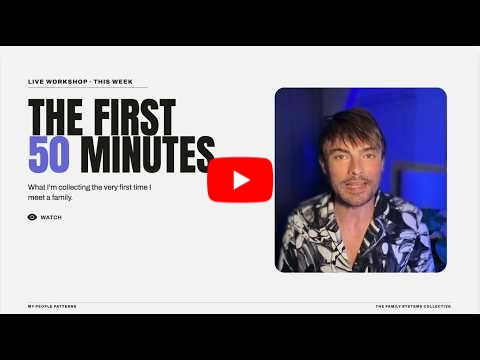
In this email, I'll walk you through the five lenses of observational data I collect in the first session, including the specific in-the-room moments to watch for under each one. This is all in anticipation of a live workshop I’m giving today at 11 am PST on The Family Systems Collective.
This week I'm sharing the five lenses I use to sort what a family shows me in a first session: organization, resonance, developmental fit, identified patienthood, and conflict resolution.
Housekeeping!
- The Big News- I'm doing a live workshop at 11am PST Today - you can access it live or watch the reruns when you join The Family Systems Collective
|
- My online Family Therapy Consultation Groups are filling up! If you want to join, get a wriggle on, because I'm capping them at 7 or 8 people, and over FIFTY people wanted to join :/
- Mondays 9am PST - click here
- Tuesdays 11am PST - click here
- Find my podcast and hit subscribe - we're on Amazon, iTunes and Spotify if you look up 'Family Systems In 15 Minutes'
1. ORGANIZATION
Structural Family Therapists are obviously interested in the structure of the family - how the family arranges power, responsibility, distance and communication. This isn’t something that a family has ever thought about, or has the language for, so it’s not like you can ask them as an intake question, ‘What’s your family structure?’
Instead, we have to infer this from what we see and, in part, from what they say.
One of the things I am on the lookout for is signs of a cross-generational alliance: a parent and a child teaming up against the other parent. A kid who has one adult's backing against the other adult can end up with more power than the parent trying to set limits, and that's often the structure beneath a teenager who runs the household, refusing to go to school, breaking curfew, etc.
The moments that show it are small, and they’re not by any means definitive, so you have to combine these observations with content and history.
- One caregiver sets a limit, and the other softens it before or undoes it- for example, Dad names a consequence, and Mom pushes back and makes it softer.
- A child rolls her eyes at Dad and glances at Mom, who smirks or at least doesn’t reprimand.
- A child starts poking her brother mid-session, and only one parent steps in to redirect, leaving the other neutral.
Again, neither of these means anything on its own, so collect several data points before you conclude anything.
2. RESONANCE
This is such an odd word, and it took me a long time to get into it, but imagine two tuning forks from science experiments. As I recall, when you smacked one tuning fork on the desk and held it next to another, the one you didn’t hit starts vibrating too. Now think of the tuning forks as people, and the vibrations as emotional states that spread from one to another.
What I’m on the lookout for is how much family members react to one another, how contagious feelings are, how aware people are of being separate individuals vs being part of an enmeshed ‘we’.
- Contagion: Dad gets angry, then all of a sudden everyone is angry.
- Mind reading. You ask the fifteen-year-old what he likes to eat, and his mother answers. She may even be right, and it still counts, because he never got to speak for himself.
- Proximity that doesn't fit the age. A fifteen-year-old wedged between both parents on the sofa goes in the notes.
The disengaged end is harder to spot because it's made of absences rather than events,, and this is something I’ll try to cover in the workshop too, because disengaged families are the opposite side of the same coin as enmeshment.
3. DEVELOPMENTAL FIT
Families, like individuals, move through developmental stages. A couple becomes parents, children start school, a child becomes a tween then teen, and young adults leave home. At each of those transitions, the family has to reorganize its structure, rules, roles, and distances. This lens asks whether the family's current arrangement fits the stage the family is actually in. The rules and roles that worked beautifully at one stage can become problematic at another. Families most often land in our offices when they've met a new situation with an old structure.
The quickest way into this lens is a single question that costs you one line of the session and sometimes hands you the whole formulation:
- "When did the problem start, and what else was changing in the family's life at that time?"
Symptom onset that clusters around a transition point, or nodal event, such as a remarriage, a move into middle school, or a job loss, is telling you where to look.
A useful distinction to draw after the session: is this pattern twenty years old, or two? A family caught between an old structure and a new developmental demand is struggling to update itself, and that calls for a very different stance from you than a long-entrenched pattern.
4. IDENTIFIED PATIENTHOOD
The identified patient is the family member the family presents as having the problem, usually a child or teenager with a symptom or problem. The presence of the identified patient is not what I’m collecting data on; I’m more interested in how central the IP is to the family. I want to know how the IP organizes the family's attention, explanations, and relationships, how negative or positive they think of the IP, and how much power they have.
I'd listen first for a language difference: is this person described as having a problem ("he's been struggling since March") or as being the problem ("he is what's wrong with this family")?
In families that are highly organized around the IP, the conversation will rarely steer away from them or the problems for long, and sometimes the identified patient steers it back themselves. The ultimate example of this that I’ve not seen too often is when the parents begin to disagree with each other, and the kid's behavior escalates at the same moment, pulling everyone's attention back to them.
5. CONFLICT RESOLUTION
Disagreement is built into family life because it’s just what happens when two people in a relationship don’t share the same opinions, so being on the lookout for conflict won’t tell you much.
More clinically useful information is found in how a family handles a disagreement once it arises. Unresolved disagreements accumulate, and that accumulation wears away at a family's cohesiveness because hurt feelings aren’t healed and compromises aren’t reached.
So this lens asks one question: what happens in this family when two people disagree?
In the workshop, I’ll tell you some of the patterns I’ve found to be useful to take note of, but in case you can’t make it, here’s one that’s instantly recognizable. It’s when a family shuts down a conflict without any exploration or compromise. The stopping almost always arrives as a recognizable line or demand:
- "Not now."
- "You look so funny when you're mad."
- "It's not really important."
- "I don't want to talk about it right now."
Which of these five lenses do you find hardest to hold onto once a session gets loud? Let me know in the comments, or better yet, come learn more in the free workshop
Until the next time,
Oliver



Responses