

I ran a treatment center for a few years, and part of that job was training therapists to think systemically, so watching a eyes glaze over as I explained how to create a hypothesis became very familiar to me.
I realize now that I was not only asking them to learn a theory, but I was asking them to hold about fifteen moving parts in their head while also insisting they change the way that they think about doing therapy.
At the same time, families arrive with a linear story and a villain already picked out, and if we don't apply our systemic way of thinking, we'll fall into the IP trap of blame and treatment won't be particularly helpful.
So this week I'm excited to share a free tool I built that helps you think differently about the family case you're working with, and how it relates to creating the part of the hypothesis that is most challenging to understand.
- Listen to the newsletter podcast episode here and I'll explain how to use it if you're on the go, driving to work or walking the dog. Find the podcast on Spotify, Apple and Amazon by searhing for 'Family Systems In 15 Minutes'
The Problem
Here is the version of this I see most often in couples work.
Billy feels disconnected and moves toward Johnny, asking for more attention. Johnny has a demanding job and feels a bit suffocated, so he works later and longer, and his sex drive disappears entirely, because there is no sexy time when you feel engulfed in your own relationship.
Billy makes an advance, Johnny isn't interested, and Billy feels lonelier than he did an hour ago. That is when Billy has a drink. Johnny finds out, Johnny gets angry, there's a blowup, Billy feels guilty, Billy drinks a bit more, and eventually everything calms down and they make up.
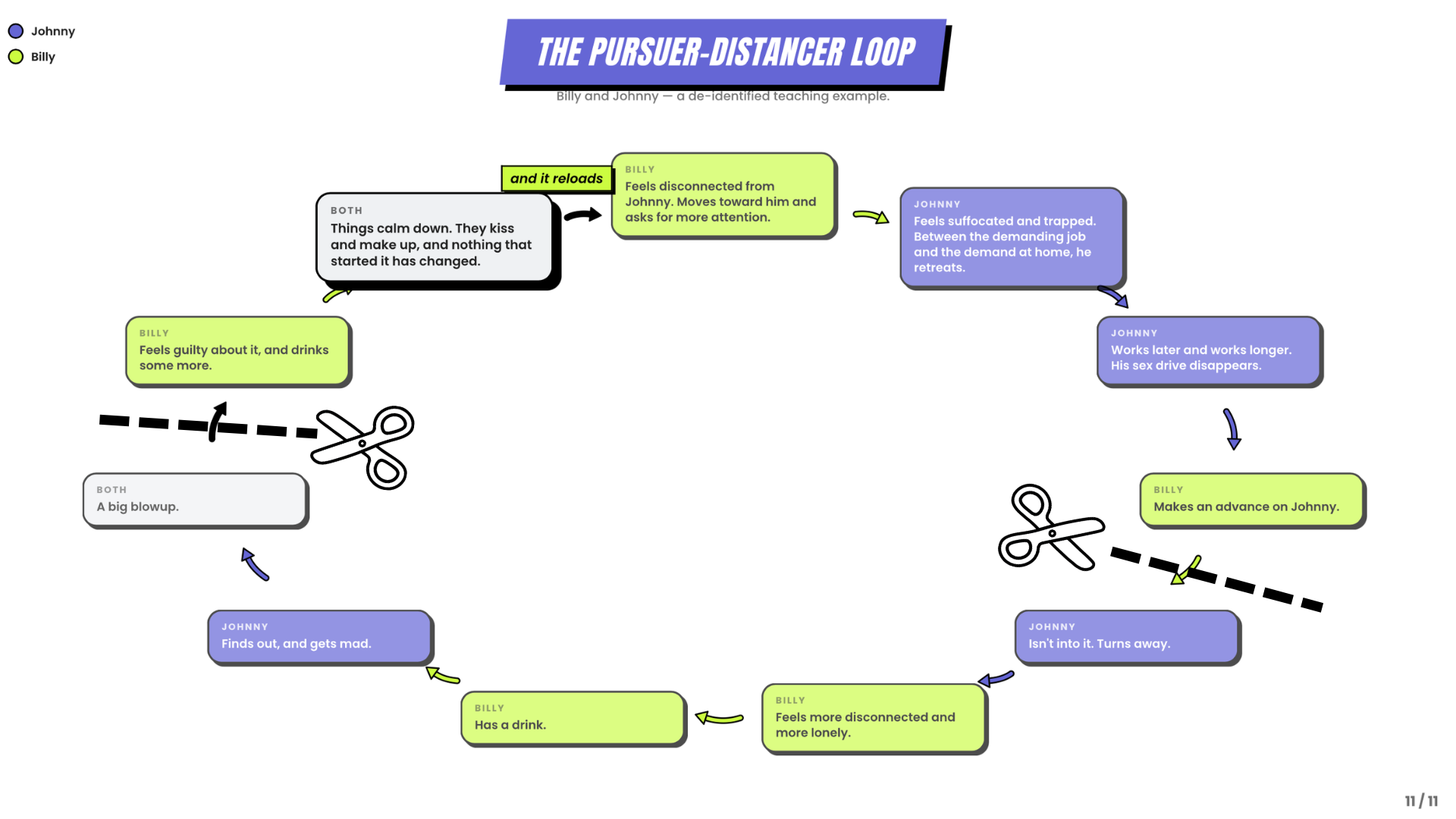
Now we're in a loop, and that changes what I'm looking for in session. Instead of asking how the drinking feels, I'm asking when Billy is more likely to drink. Is it when Johnny gets home late? Is it when Johnny yells? Is it when Johnny ignores him? Once the loop is visible to me, and ideally to them, I can break the chain at any point on the map, because changing the direction of any one arrow stops the whole sequence from completing.
The Six Parts Of A Behavioral Loop
Every behavioral loop has at least six categories in it,
1. THE TRIGGER What happened immediately before the problem behavior started. This is almost never the thing the family leads with, because they lead with the behavior. In the family I'll show you in a minute, the parents were giving the younger sister a lot of praise, and that was the moment the older brother got upset.
2. WHAT EVERYONE DOES Every person's move during the episode, including the ones who look like bystanders. This is the joint most of us leave the session without, because the trained instinct is to turn to the upset person and ask how they felt, which keeps you inside one person's experience and leaves the other three people blank on your map. So the better question is what each person did while it was happening, one name at a time.
3. THE ATTEMPTED SOLUTION What each person tries in order to fix the problem, which is usually the thing keeping it alive. Johnny works later to get some breathing room, and the breathing room is exactly what makes Billy feel disconnected enough to drink.
4. HOW THE EPISODE ENDS The blowup, the guilt, the storming upstairs, the making up. Episodes end in a reliable way in most families, and the ending is often the part that delivers the closeness or the relief that makes the whole sequence worth repeating.
5. WHO OUTSIDE GETS INVOLVED Grandparents, a teacher, a school counselor, the psychiatrist, the sibling who never comes to session. Not everyone in the system sits in your room, and the people who aren't there still have a move in the sequence.
6. THE RESET The hours or days afterward when everyone calms down and nothing gets addressed or talked about. That silence is the reload, and it is the reason another episode becomes possible by the weekend.
THE TOOL I MADE FOR YOU
I built a free AI case formulation tool, and it lives inside the Family Systems Collective. You open the page, type in what you know about a case, and it interviews you about the sequence. It asks like a decent supervisor would, one question at a time, in order, and it keeps track of what you've already told it so you're never repeating yourself.
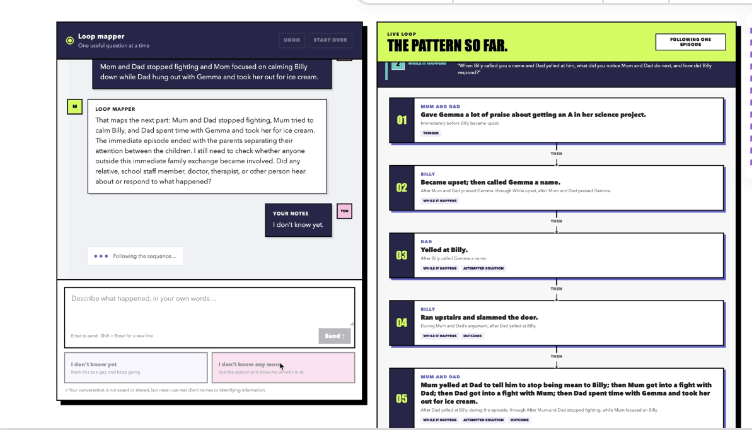
Three things are happening while you type.
It builds the map as you talk. Every time you describe a move, who did what and what happened next, another step drops into a visual loop on the side of your screen. You watch the formulation assemble itself out of your own answers, which is a strange and quite satisfying thing to sit through.
It keeps a list of what you don't know. When you say you have no idea what Dad did next, it doesn't push you, and it doesn't invent an answer. It marks that as a gap, so you leave with a record of what to ask next time. This is the part I found most useful on my own cases. I thought I was reasonably good at getting a basic loop, and it showed me how much more detail I could have been building.
It gives you circular questions for every gap. When you hit a blank, it drafts questions you can take into the next session, and they collect in their own section next to the map. Say Gemma's move after the name-calling is missing, and it will offer something along the lines of asking Gemma what she noticed Mom and Dad do next, and how Charlie responded to that.
Take the case you're most stuck on, open the tool, and answer until it stops asking. Say "I don't know" as often as it's true, because the gaps are the output you actually want. You'll leave with a map, a printable page, and a short list of questions for the next session.
The tool is free and it lives inside the Family Systems Collective, which is also free. You'll need to log in, and after that it's yours to use as often as you like. Join here and come say hello, and tell a colleague who's stuck on a case this week.
This one was built because Rachel and Gary in the Collective asked how family therapy case formulation actually works, so if there's another AI tool that would make your week easier, let me know what it is and I'll see what I can build.
Until the next time, Oliver



Responses