
If you've read Yalom in Grad School, or just for fun, you probably have a sense of what the 'Here and Now' aspect of group therapy is all about, but how to you actually get more of it in your group?
The Modern Group Analytic equivalent to the Here and Now is 'Immediacy' and what I love most about this school of thinking is that it's a theory of group therapy techniques, meaning, the focus is on 'what to do'.
In the latest group therapy video I share more about this and give you some ideas on how to bring more aliveness into the room.
What Is Immediacy?
Immediacy is what happens when the group stops talking about the past and starts living it out right in front of you. There's a particular electricity to it and that is the thing about immediacy that I think gets undersold: it's not just a technique you apply. It's a quality that a group builds over time, a charged, continuous engagement with the present moment where nobody quite knows what's coming next.
That unpredictability is the whole point. Because when a patient has spent thirty years managing their relationships at arm's length, you can describe that pattern to them, you can name it, you can draw it on a whiteboard if you want, and they'll nod. But when it happens live, in the group, in front of eight other people who are watching, that's the moment something might actually shift.
 |
Why The Group Resists The Here and Now
Groups resist immediacy because immediacy is uncomfortable, and discomfort has a way of making people very creative about avoiding it. Members intellectualize, they report, they analyze their feelings rather than having them, and the whole group can slide into a comfortable distance from the present moment without anyone technically doing anything wrong.
Underneath that, at the individual level, what you're often dealing with is a fear of exposure, vulnerability and intimacy. At the group level, it gets even more interesting, because a group develops its own collective anxiety about how much vulnerability is allowed into the room.
Resisting immediacy is how the group keeps the terror of emotional connection at a manageable distance.
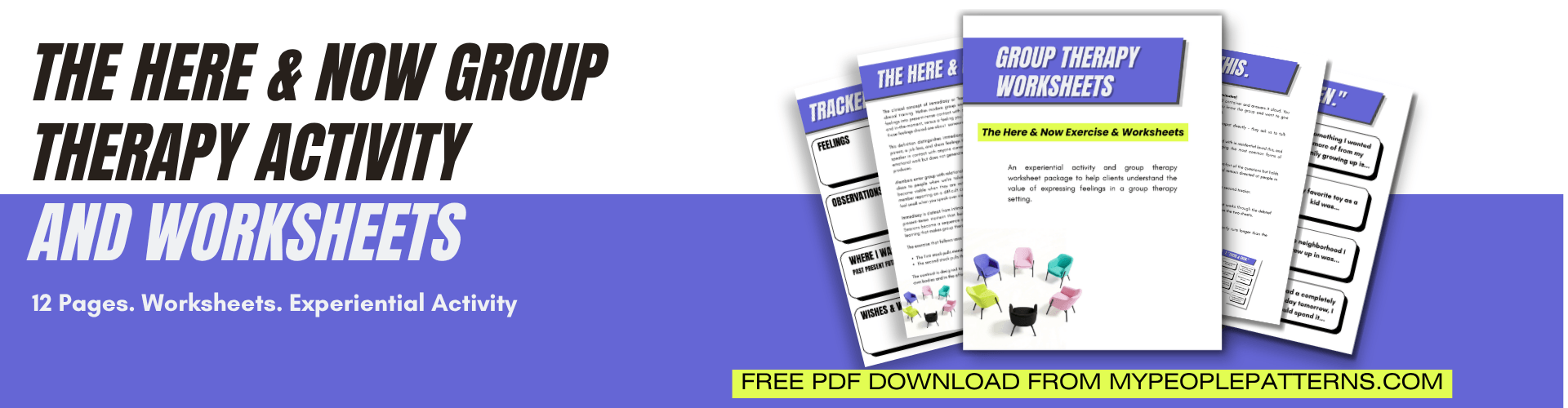
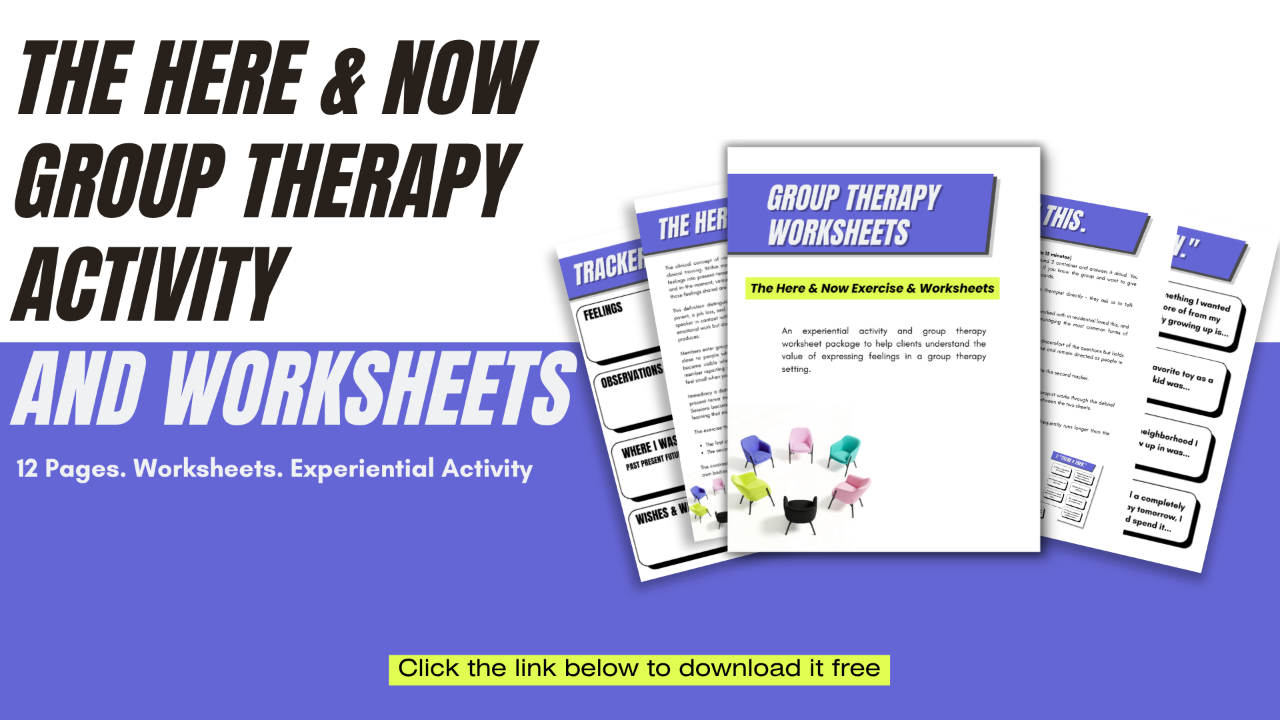
Grab the experiential activity and group therapy worksheets I mention in the video here:
Techniques For More Of The Here and Now
So once you understand why groups resist immediacy, the next question is what you actually do about it. And the good news is that there are specific moves you can make as a therapist to bring a group back into the present moment when they've drifted out of it.
Translate The Past
When a member, or the whole group, retreats into historical material, childhood complaints, parental failures, old wounds, the instinct is often to follow them there and do good therapeutic work on the content.
The more clinically interesting question is what that historical material is doing in the room right now, and who in the room is carrying it. If a group has formed what you might call a lamenting chorus about parental neglect, you can cut through that fairly directly by asking something like:
- "How am I neglecting you in this group?"
Bring The Outside In.
Members will often spend a lot of time reporting on their external relationships, a difficult colleague, a distant partner, a controlling parent, as if the group is a place to process events that happen elsewhere. And there's value in that, up to a point. But when outside stories become a habitual way of keeping the group at arm's length, you can bring those reported experiences directly into the room with one question:
- "If someone in this group were to treat you the same way, who would it be?"
That kind of question transforms a detached narrative into a live issue. Now there's someone sitting across from them who might actually embody the dynamic, and the group has something real to work with.
Block The Rewind
Groups sometimes resist forward momentum not by retreating to childhood but by doubling back on something that just happened, a comment from five minutes ago or last session.
That can feel productive because it's sort of recent and maybe specific. But it's often a version of the same avoidance tactic, using the immediate past as a way to stop the group from moving forward into the discomfort of what's happening right now. Your job in those moments is to keep the group moving.
- "Before we revisit that moment, I'm curious what feelings came up in you right now that made you ask that?"
Refusing to halt the group for one member's need to revisit a past slight isn't insensitivity; it's a clinical decision to keep things alive and to stop a group norm of rewinding into the past from taking hold.
Make It Direct
Some members have a style of speaking that keeps their actual feelings very well hidden. You'll see it as advice-giving, pseudo-reflective commentary, what you might describe as AI generated talking points, where everything is processed and flattened before it gets said.
The temptation is to challenge that member directly, to name what you're seeing and ask them to drop the defense. That sometimes works, but a more interesting move is to redirect to the group.
- "Jenny, how does it feel to get advice like that from Ken?"
When the group reacts honestly, the advising member can't stay hidden behind their role anymore. Their underlying anxiety, or their anger, or whatever is driving the performance, starts to become visible.
You could also bridge to another group member to open up the conversation about what might be behind the chat-gpt nugget of wisdeom someone dropped.
- "Barbie, what do you think Ken's feeling when he offers those nuggets of wisdom?"
Bridging is one of the core skills I teach in GTX: Group Therapy Training, the new course I'm finishing up. I've love for you to check it out and tell me what else you'd like me to cover in it.

More next week, and as always, let me know in the comments what other group therapy topics would be helpful for me to cover?
Oliver & My People Patterns


Responses